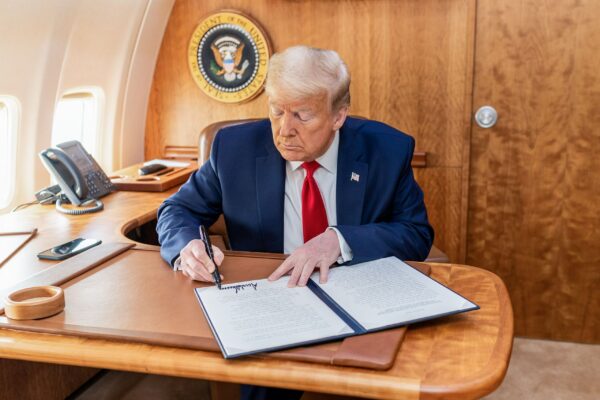
President Donald Trump renewed his push Thursday for Senate Republicans to eliminate the filibuster, arguing the move is necessary to advance their agenda quickly ahead of the upcoming midterm elections.
In a post on Truth Social, Trump warned that Democrats would not hesitate to take the same step if they regain control of the Senate, urging Republicans to act decisively rather than risk being outmaneuvered.
“How much abuse can the Republican Senate take,” Trump wrote, before calling on lawmakers to “BLOW UP (TERMINATE!) THE FILIBUSTER” and pass legislation “at a record clip,” including proposals like the Save America Act. He framed the issue as a matter of urgency, suggesting that failure to act could leave Republicans at a disadvantage if political control shifts.
The filibuster, a long-standing Senate rule requiring a supermajority to advance most legislation, has often been defended as a safeguard encouraging compromise and preventing abrupt swings in policy. But Trump has repeatedly argued it stands in the way of delivering on key priorities, particularly in a divided political climate.
The president has also pointed to specific legislative goals, including passing the House version of a funding bill aimed at ending a partial government shutdown and fully funding Immigration and Customs Enforcement. In his view, the current rules make it unnecessarily difficult to enact measures that already have support within the party.
Still, Trump’s call has run into resistance from within his own ranks. Senate Majority Leader John Thune has made clear that eliminating the filibuster is not under serious consideration, describing it as an unrealistic option despite pressure from the White House.
Thune has acknowledged the potential political fallout from opposing Trump on the issue but signaled a willingness to withstand that criticism. His stance reflects a broader concern among some Senate Republicans that removing the filibuster could backfire in the long run, particularly if Democrats regain power and use the same tool to push through their own agenda.
The divide highlights a familiar tension in Washington: the desire to move legislation swiftly versus the risks of eroding institutional guardrails. While Trump emphasizes speed and efficiency, critics within the party appear wary of setting a precedent that could lead to more volatile policy shifts in the future.
Trump has not backed down from his position. In recent weeks, he has intensified his rhetoric, calling out Republicans who oppose ending the filibuster and accusing them of standing in the way of progress. In a late March post, he argued it was “time for the Senate Filibuster to END,” labeling dissenting GOP senators as “weak and ineffective.”
The debate comes at a moment when control of the Senate remains politically significant, with both parties eyeing the midterms as a chance to solidify or reclaim power. Trump’s warning that Democrats would move quickly to eliminate the filibuster if given the opportunity adds another layer of urgency to his argument.
At its core, the dispute underscores a broader question about how the Senate should function. While the filibuster has long been criticized as an obstacle to action, it has also served as a brake on rapid legislative changes. As Republicans weigh their options, the challenge lies in balancing immediate political goals with the long-term consequences of altering the rules that govern the chamber.
[READ MORE: Trump Weighs Troop Drawdown in Germany as Tensions Simmer Over Iran Strategy]