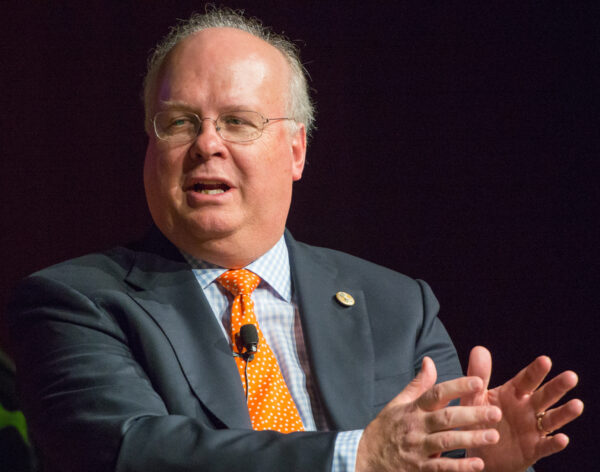
A recent Supreme Court decision striking down a racially drawn congressional district in Louisiana is sparking debate, but veteran political strategist Karl Rove is arguing the outcome may ultimately expand, not diminish, the influence of Black voters.
Appearing Thursday on “America’s Newsroom,” Rove pushed back on claims that the ruling would weaken minority representation, instead framing it as a shift away from rigid, race-based districting practices that have long shaped parts of the electoral map.
Rove explained that districts in states like Louisiana and Alabama were often drawn in highly unusual ways to comply with the Voting Rights Act, with one central goal: ensuring a majority of Black voters within a single district. Over time, he said, that requirement led to increasingly contorted maps designed to maintain those racial majorities from census to census.
“These are drawn for one purpose and one purpose only,” Rove said, describing the process of constructing districts where race becomes the defining factor. He added that similar logic applied to other racial groups would likely be viewed as unacceptable, a point echoed by anchor Bill Hemmer during the discussion.
The conversation turned to concerns that the court’s ruling could leave Black voters without adequate representation. Co-host Dana Perino raised the question many viewers might hear in the days ahead: whether critics claiming the decision is a “disaster” have a valid case.
Rove’s response was measured, noting first that the immediate electoral impact may be limited. Many states have already completed key steps in the election process, including primaries and filing deadlines. Alabama, he pointed out, has acknowledged the need to redraw its map but indicated changes would not take effect until a future election cycle. Louisiana is still weighing its options.
More broadly, Rove argued the decision could reshape how political parties approach Black voters. Rather than concentrating those voters into a single majority district, new maps could distribute them across multiple districts that are more geographically compact and tied together by shared community interests.
That shift, he suggested, could increase competition for Black voters’ support. Instead of assuming representation depends on a single majority-Black district, candidates from both parties may now have stronger incentives to engage with Black communities across a wider range of districts.
“I see it just the opposite,” Rove said, pushing back on claims of diminished influence. He described the previous system as one that effectively grouped voters by race, while the new approach could integrate them into broader constituencies.
The regions in question, including parts of southwestern Alabama and northwestern Louisiana, could see political dynamics evolve as a result. Candidates seeking office may need to build broader coalitions and appeal to more diverse electorates, rather than relying on heavily segmented districts.
At the same time, the debate highlights ongoing tensions over how best to balance fair representation with concerns about race-based decision-making in politics. While the court’s ruling removes one approach to ensuring minority representation, it also raises questions about what replaces it—and how effectively those alternatives will serve voters.
For now, Rove’s argument underscores a central theme: that political influence is not solely determined by district lines, but also by how actively parties and candidates compete for voters’ support.
[READ MORE: Trump Weighs Troop Drawdown in Germany as Tensions Simmer Over Iran Strategy]