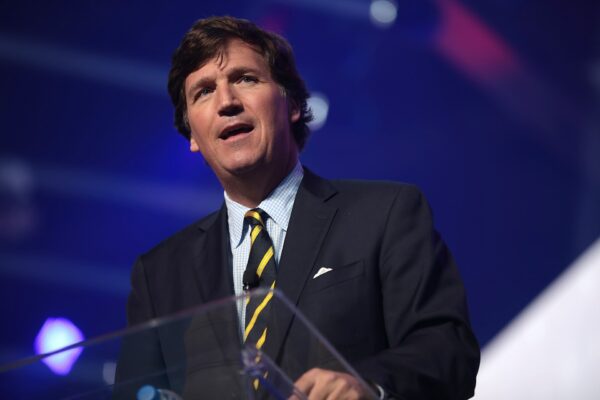
President Donald Trump is spotlighting a new poll showing his dominance among Republican voters, using the moment to take direct aim at conservative commentator Tucker Carlson amid a growing rift within the right over foreign policy and the ongoing conflict with Iran.
In a Friday morning Truth Social post, Trump celebrated the results of a survey conducted by the University of Massachusetts Lowell’s Center of Public Opinion, which was highlighted during a CNN segment. The poll found that 77 percent of Republicans view Trump favorably, compared to just 31 percent who said the same of Carlson. Another 24 percent of Republicans reported an unfavorable view of the former Fox News host.
Rather than treating the results as a routine political snapshot, Trump used them as an opportunity to escalate his criticism. “It’s easy!” he wrote, calling Carlson “a Low IQ person” and “highly overrated.” The president expanded his critique to include other media figures, taking aim at Megyn Kelly, Candace Owens, and Alex Jones in similarly blunt terms. He contrasted them with what he described as “VERY GOOD” supporters aligned with his political movement, suggesting he might even compile a list ranking allies and critics.
The sharp rhetoric comes as Carlson has increasingly positioned himself as a vocal critic of the administration’s military actions abroad. Since the U.S., alongside Israel, launched strikes against Iran at the end of February, Carlson has raised concerns about the direction and implications of the conflict. His criticism reflects a broader unease among some conservatives who question both the objectives and the potential duration of the engagement.
Trump, however, has shown little patience for dissent within his own ranks. In a separate Truth Social post on Thursday evening, he lashed out at Carlson and others who have expressed skepticism about the conflict, dismissing them as “stupid people” seeking attention. He argued that critics lack credibility and have lost their influence, accusing them of saying anything necessary for publicity.
The feud intensified following a controversial Easter Sunday message from Trump that concluded with the phrase “Praise be to Allah.” Carlson responded during his podcast by accusing the president of mocking religion, specifically Iran’s faith traditions. He argued that such rhetoric risks crossing a line, suggesting that disrespecting religion could inflame tensions rather than ease them.
“Who do you think you are?” Carlson said, criticizing the tone of the message. He warned that mocking religious beliefs, regardless of political disagreements, undermines the broader concept of faith and could deepen divisions at a time when tensions are already high.
The clash between Trump and Carlson highlights a deeper divide within conservative circles, particularly over the question of military engagement. While the poll numbers suggest Trump maintains strong support among Republican voters, the disagreement underscores that unity is not absolute—especially when it comes to foreign policy decisions with far-reaching consequences.
As the conflict with Iran continues, the exchange serves as a reminder that debates over war are rarely confined to party lines. Even among allies, questions about strategy, tone, and long-term impact can spark sharp disagreements. And in a political climate already defined by intensity, those divisions are playing out not just in policy discussions, but in increasingly personal terms.
[READ MORE: Trump Declares Israel “Prohibited” From Striking Lebanon as Strait of Hormuz Reopens]