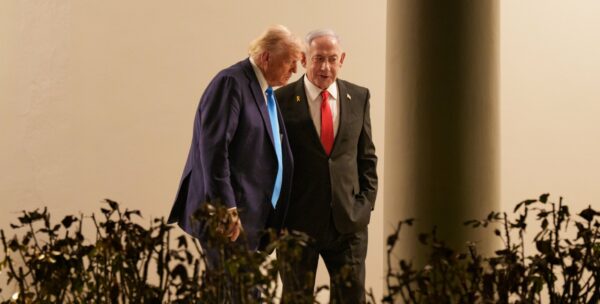
President Donald Trump issued a series of forceful statements Friday morning, declaring that Israel is “prohibited” from launching further strikes on Lebanon while also celebrating news that a key global shipping route has reopened.
In a Truth Social post, Trump made clear his position on the ongoing tensions involving Israel and Lebanon, stating bluntly that Israeli military action against Lebanon would no longer continue. “Israel will not be bombing Lebanon any longer. They are PROHIBITED from doing so by the U.S.A. Enough is enough!!!” he wrote, signaling a firm stance amid a volatile regional situation.
The president’s remarks came alongside comments about a separate arrangement involving what he described as nuclear “dust” generated by U.S. B-2 bombers. Trump said the United States would take possession of this material and emphasized that no money would be exchanged as part of the arrangement. He also noted that the understanding was not tied to Lebanon, though he added that the U.S. would continue working with the country and address the situation involving Hezbollah “in an appropriate manner.”
Trump reiterated that distinction in a follow-up post, writing that the agreement stood independently of Lebanon while also pledging continued engagement with the country. “This deal is not tied, in any way, to Lebanon,” he said, adding a slogan-style message about strengthening ties going forward.
At the same time, the president pointed to what he framed as a positive development for global commerce and stability. He celebrated Iran’s announcement that the Strait of Hormuz—one of the world’s most critical energy corridors—was “completely open” for commercial traffic during the current ceasefire period.
“IRAN HAS JUST ANNOUNCED THAT THE STRAIT OF IRAN IS FULLY OPEN AND READY FOR FULL PASSAGE,” Trump wrote in all caps. “THANK YOU!”
The announcement followed a statement from Seyed Abbas Araghchi, who said that, in line with the ceasefire in Lebanon, commercial vessels would be allowed to pass through the strait along previously coordinated routes. The waterway carries roughly 20 percent of the world’s oil supply, making its status a matter of global economic importance.
Recent reports have indicated that Iran had been targeting and imposing tolls on cargo ships in the region following strikes carried out by Israel and the United States, adding to tensions and uncertainty surrounding the route.
Trump’s comments reflect a broader effort to project control and stability at a moment when multiple flashpoints remain active. By publicly drawing a line on Israeli strikes while highlighting the reopening of a vital shipping lane, the administration appears to be signaling a desire to de-escalate certain aspects of the conflict even as it continues to engage with complex security challenges.
Still, the developments underscore the delicate balance at play. Military actions, ceasefire arrangements, and economic lifelines like the Strait of Hormuz are tightly intertwined, and shifts in one area can quickly ripple across others. As the situation evolves, the challenge for policymakers remains not only in asserting strength but in navigating the consequences that often follow when conflicts expand beyond their original scope.
[READ MORE: Trump Says Don’t Panic Over Oil Prices]