As the conflict with Iran approaches a critical legal threshold, two Senate Republicans are signaling that their support for continued military action may not be indefinite—raising fresh questions about Congress’s role in authorizing war and how long the current operation should continue.
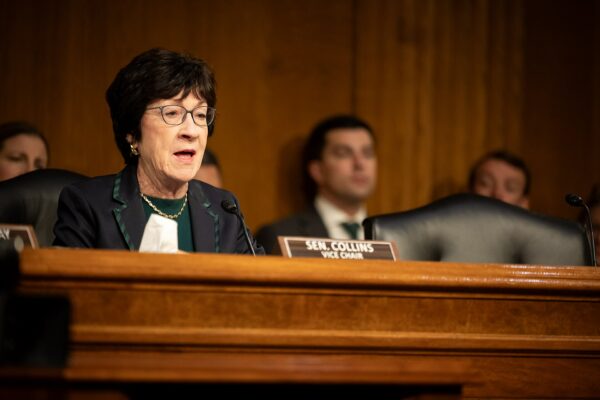
Sen. Susan Collins (R-Maine), long viewed as a centrist voice in the Republican conference, indicated this week that her position could shift if the conflict extends beyond the 60-day window outlined in the War Powers Resolution of 1973. Speaking at the Semafor World Economy summit, Collins made clear she had hoped the operation would be both swift and decisive.
“It is very likely that I would vote not to authorize further hostilities,” Collins said, adding that she has maintained from the outset that prolonged engagement would require congressional approval. She emphasized that once the 60-day mark is reached, the law requires the president to seek authorization from lawmakers to continue military operations.
Sen. Thom Tillis (R-N.C.) echoed similar concerns in an interview with NBC News, pointing to the approaching deadline as a moment of consequence. While not ruling out continued involvement entirely, Tillis acknowledged growing unease about the trajectory of the conflict.
“What’s concerning me now is we’re coming up on the 45-day mark,” Tillis said, noting that the 60-day limit carries significant weight under federal law. He also raised questions about the clarity of the mission, saying he was “not quite clear what the strategic objectives are.”
The War Powers Resolution, enacted in 1973, was designed to ensure that Congress retains a central role in decisions to commit U.S. forces abroad. It requires the president to notify lawmakers within 48 hours of initiating military action and prohibits forces from remaining engaged for more than 60 days without explicit authorization.
That deadline is fast approaching in the current conflict, which began on Feb. 28 with joint U.S.-Israel strikes targeting Iranian leadership, military infrastructure, and nuclear facilities. Since then, Democrats in both chambers have pushed for multiple votes aimed at limiting the president’s authority to continue the campaign without congressional approval.
So far, those efforts have been unsuccessful. Republicans have largely held the line, arguing that imposing restrictions could weaken national security and undermine the effectiveness of ongoing operations. In the most recent vote Wednesday, Senate Republicans blocked a fourth attempt to rein in the president’s authority in a 47-52 vote that fell largely along party lines. Sen. Rand Paul (R-Ky.) broke with his party to support the resolution, while Sen. John Fetterman (D-Pa.) crossed over to oppose it.
Still, the debate is far from settled. The continued military engagement has exposed divisions within the GOP itself, as some lawmakers grow increasingly cautious about the duration and scope of the conflict. That unease has been compounded by mixed signals from Donald Trump regarding the status of the operation.
“I will say the war in Iran is going along swimmingly,” Trump said during a speech in Las Vegas, adding that it “should be ending pretty soon.” The comments offered optimism but did little to clarify the long-term plan or benchmarks for success.
Meanwhile, Sen. Lisa Murkowski (R-Alaska) has been working with colleagues on a potential resolution that would formally authorize military force beyond the 60-day limit, suggesting that Congress may ultimately need to step in if the conflict continues.
Tillis has indicated he is open to additional funding for the military effort but stopped short of a firm commitment, saying he would need to review the details before offering support.
As the clock ticks toward the legal deadline, the situation underscores a familiar tension in Washington: balancing national security priorities with constitutional limits. While many Republicans remain reluctant to constrain the president in the midst of an ongoing conflict, the growing calls for clarity—and restraint—suggest that even within the party, there is increasing recognition that prolonged military engagements come with serious questions that cannot be ignored.
[READ MORE: Trump Declares Israel “Prohibited” From Striking Lebanon as Strait of Hormuz Reopens]