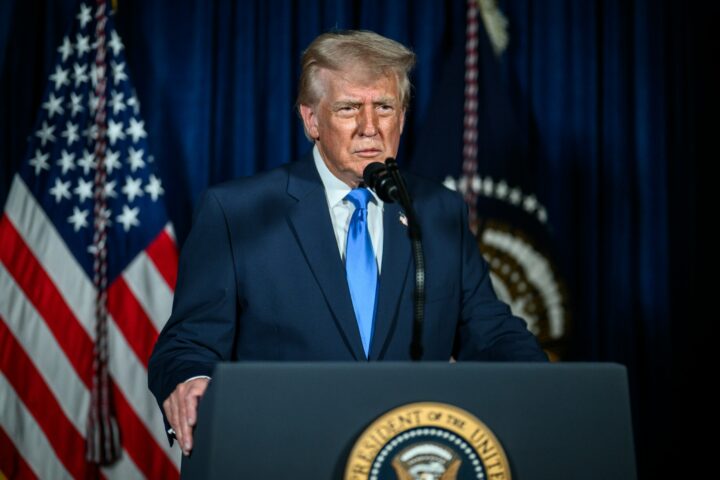
President Donald Trump said Sunday that he has instructed U.S. negotiators not to rush an agreement with Iran, tempering expectations that a deal to reopen the Strait of Hormuz is imminent despite signs of progress from both sides.
Trump wrote on Truth Social that the U.S. blockade on Iranian vessels in the Strait of Hormuz will remain “in full force and effect until an agreement is reached, certified, and signed.”
He said negotiations were moving forward and that U.S.-Iran relations had become more professional and productive, but cautioned that a final agreement should not be hurried.
“Both sides must take their time and get it right. There can be no mistakes!” Trump wrote.
The statement came one day after Trump said the two sides had “largely negotiated” a memorandum of understanding on a peace agreement that would reopen the Strait of Hormuz, one of the world’s most important energy corridors. Before the conflict, the waterway carried roughly one-fifth of global oil and liquefied natural gas shipments.
Trump has repeatedly suggested that a deal could end the war, which began after the U.S. and Israel launched military action against Iran on February 28. But no agreement has been finalized, and major disputes remain unresolved.
It was not immediately clear whether Trump’s Sunday remarks referred to the preliminary memorandum under discussion or a broader peace accord that would likely take longer to negotiate.
The sides remain divided over Iran’s nuclear program, Tehran’s demand for sanctions relief, and the release of tens of billions of dollars in frozen Iranian oil revenues held in overseas banks.
U.S. and Iranian media reports have said the proposed memorandum, if completed, would end the U.S. blockade on Iranian shipping and reopen the strait, which Iran had effectively closed through threats against vessels.
A senior Iranian official previously told Reuters that any memorandum approved by Iran’s Supreme National Security Council would then be sent to Supreme Leader Ayatollah Mojtaba Khamenei for final approval.
But Iran’s Tasnim news agency reported that differences remained over one or two clauses. The outlet quoted a source saying a final agreement would not be possible if the United States continued creating obstacles.
In a separate complication, a military adviser to Khamenei said Tehran has the legal right to control the Strait of Hormuz, though it was unclear whether that claim meant Iran would continue asserting authority over which ships may pass.
Any agreement that strengthens the fragile ceasefire could calm global energy markets. But it would not immediately resolve the broader energy crisis that has driven up prices for fuel, fertilizer, and food.
Even if the fighting ends now, full shipping volumes through the strait are not expected to resume until the first or second quarter of 2027, according to the head of the Abu Dhabi National Oil Company.
Iran’s Revolutionary Guards said 33 vessels had passed through the strait in the past 24 hours with Tehran’s approval. Before the war, roughly 140 ships transited the waterway each day.
Trump’s objectives during the conflict have shifted at times, but he has consistently said the U.S. campaign was intended to prevent Iran from acquiring nuclear weapons. He repeated that position Sunday.
“Iran must understand, however, that they cannot develop or procure a Nuclear Weapon or Bomb,” Trump said.