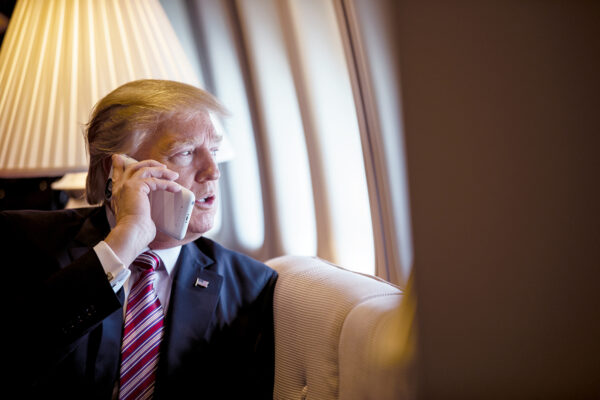
President Donald Trump sharply criticized major media outlets late Monday, accusing them of undermining U.S. military personnel while fueling skepticism about America’s ability to secure Iran’s uranium stockpile.
In a post on his Truth Social platform, Trump took aim at CNN and what he described as “other corrupt Media Networks,” arguing that their coverage sought to “demean or belittle” American aviators. The president insisted that last summer’s military action—referred to as Operation Midnight Hammer—had already delivered decisive results.
According to Trump, the operation amounted to a “complete and total obliteration” of key nuclear-related sites in Iran. He suggested that any effort to recover material from those locations would now be a difficult and time-consuming task, while maintaining that the success of the strikes deserved greater recognition.
The remarks come amid ongoing questions about the status of Iran’s enriched uranium. Trump had previously claimed that Tehran had agreed to hand over its stockpile, though that assertion has not been confirmed by Iranian officials or international intermediaries. At the same time, uncertainty persists on the ground. Inspectors from the International Atomic Energy Agency have not been able to verify Iran’s near weapons-grade uranium since June 2025, when U.S. and Israeli strikes targeted enrichment facilities.
While Trump did not cite a specific report, his comments followed a segment on CNN that explored the feasibility of retrieving uranium through a military operation. During the discussion, national security analyst Alex Plitsas spoke with anchor Anderson Cooper about the challenges such a mission would present.
Cooper characterized the difficulty of such an operation as “mind-boggling,” a sentiment echoed by Plitsas, who acknowledged that while certain U.S. military units might be capable of attempting it, the undertaking would be “incredibly complex” and “highly risky.” He pointed to Iran’s continued ability to launch drone attacks, referencing an earlier mission in April to rescue downed aviators that came under fire.
Plitsas also noted that extracting uranium had been considered only as a contingency plan prior to Operation Midnight Hammer, which ultimately relied on bunker-busting munitions to strike nuclear infrastructure. The discussion highlighted the gap between theoretical capability and practical execution, especially in a contested environment.
Adding to the caution, Andrew Weber, a senior fellow at the Council on Strategic Risks, described the prospect of such a mission as “next to impossible.” He argued that carrying out an extraction in hostile territory would require sustained presence and protection for U.S. personnel, potentially involving thousands of troops over an extended period.
Weber suggested that a negotiated outcome would be a more viable path, emphasizing the risks associated with a prolonged military operation deep inside Iran. His assessment reflects a broader concern that even limited objectives can quickly expand into more complicated and dangerous engagements.
Trump’s criticism of the media underscores a familiar tension between the administration and major news organizations, particularly on issues of national security. At the same time, the underlying debate points to a more sobering reality: even as leaders project confidence, the mechanics of war—especially in a region as volatile as Iran—remain fraught with uncertainty, complexity, and the potential for escalation that few seem eager to fully embrace.