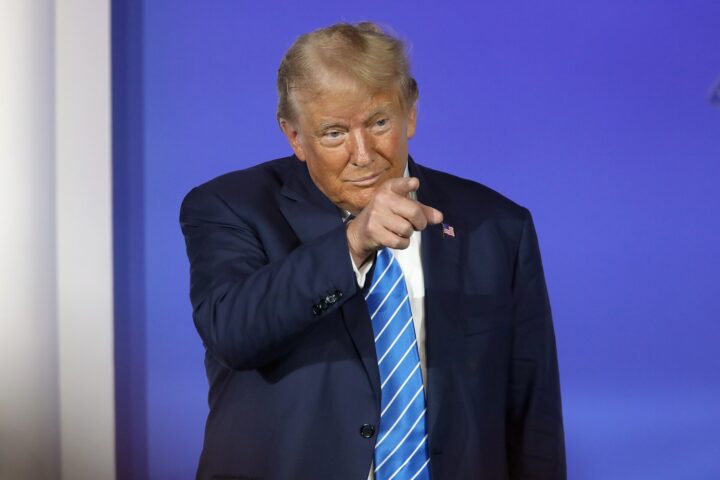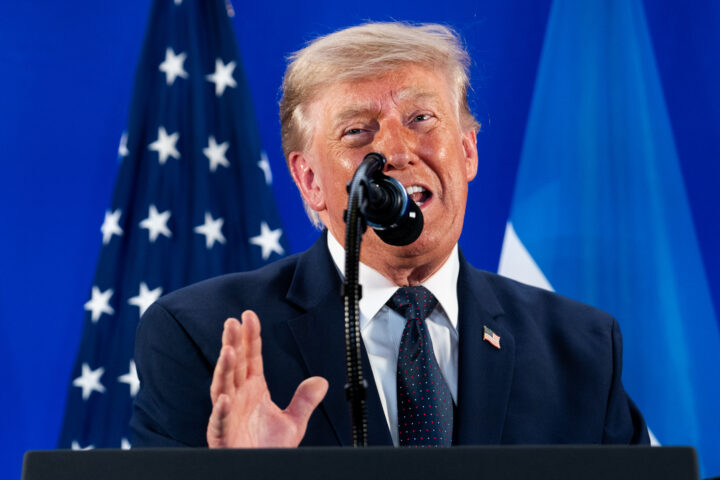
President Donald Trump is forcefully pushing back on claims that Israeli Prime Minister Benjamin Netanyahu pressured the United States into war with Iran, insisting the decision was driven by his own long-held views and the impact of the October 7, 2023 terrorist attack.
In a Monday morning post on Truth Social, Trump declared he was “never” talked into launching what has been referred to as Operation Epic Fury. Instead, he pointed to the October 7 assault on Israel—an attack that killed roughly 1,200 people and saw hundreds taken hostage—as the moment that reinforced his belief that Iran must never be allowed to obtain a nuclear weapon.
Trump framed the move as consistent with his broader worldview, arguing that the brutality of the attack only solidified a position he says he has held for years. While critics have suggested U.S. involvement reflected Israeli influence, the president made clear he views the conflict through a different lens—one centered on perceived threats and long-standing national security concerns.
The president also took aim at media coverage of the conflict, accusing “fake news pundits and polls” of distorting public understanding. He argued that the press has failed to properly highlight what he considers successful outcomes tied to his foreign policy approach, including a U.S. operation in Venezuela that resulted in the capture of leader Nicolás Maduro.
Drawing a comparison between Venezuela and Iran, Trump predicted that the outcome of the Iran conflict would ultimately be “amazing,” particularly if new leadership emerges. Still, even as the president projects confidence, the broader reality of war remains far less predictable. Military campaigns, no matter how decisive they appear at the outset, often unfold with consequences that are difficult to fully control.
This is not the first time Trump has rejected the idea that Israel drove the U.S. into the conflict. In an earlier exchange with ABC News, he suggested the opposite may be true, saying, “I might’ve forced their hand.” Trump argued that his administration believed Iran was preparing to strike first and that preemptive action was necessary.
That claim aligns with broader reporting that the administration viewed Iran as an imminent threat, though such decisions have sparked debate about the risks of escalation and the long-term impact of military engagement. Even among those who support a hardline stance on Iran, there is recognition that conflicts in the region rarely resolve cleanly or quickly.
At the same time, Trump has continued to praise Israel as a key ally, describing the country as “courageous, bold, loyal, and smart” in recent remarks. His strong support underscores the close relationship between the two nations, even as questions linger about how the conflict will ultimately unfold.
Despite the tough rhetoric, Trump has also expressed optimism about a potential resolution. He said a deal with Iran could come together soon, possibly as early as Monday in Pakistan, though no agreement has been finalized. At the same time, he warned that if negotiations fail, he would consider escalating military action by targeting critical Iranian infrastructure.
That dual message—hope for a deal paired with the threat of further escalation—captures the uneasy balance at the center of the current moment. Leaders often project certainty in times of conflict, but the path forward remains uncertain, and the costs of prolonged war can grow quickly, even when framed as necessary.
[READ MORE: Fetterman Breaks With Democrats, Slams Party’s Response to Iran Conflict]