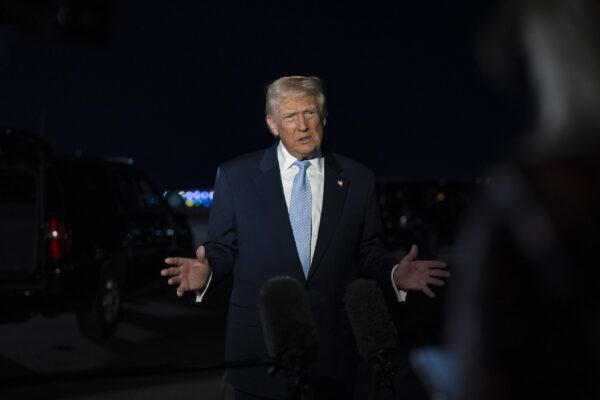
Congressional Republicans are rejecting claims that the United States is engaged in a full-scale war with Iran, instead arguing that President Donald Trump’s military actions represent a limited response to hostile acts carried out by the Iranian regime.
GOP lawmakers say the current operations are focused, strategic measures aimed at protecting Americans and preventing further aggression from Tehran, not a formally declared war.
“This isn’t a war. We haven’t declared war,” Sen. Markwayne Mullin (R-Okla.) said during an appearance on CNN Monday. Mullin argued that the conflict stems from actions taken by Iran’s leadership.
“Iranian Supreme Leader Ayatollah Ali Khamenei declared war on us. We are not at war with the Iranian people,” Mullin said.
He added that the United States is focused on preventing Iran from threatening American interests.
“We’re not at war with Iran. We’re making sure that they do not have the capability to harm us anymore,” Mullin said.
The debate over terminology comes as Republican leaders in both the House and Senate work to defeat war powers resolutions backed by Democrats that would restrict the president’s authority to conduct military operations against Iran.
Supporters of those resolutions argue that Congress alone has the constitutional authority to declare war and that lawmakers should be required to formally authorize the president’s actions.
House Minority Leader Hakeem Jeffries (D-N.Y.) said during a press conference Tuesday that Congress must assert that authority.
“This power was explicitly given to the Congress, and now it’s the Congress’s responsibility to go on record because Donald Trump has unconstitutionally and illegally chosen to launch a war,” Jeffries said.
Republicans, however, contend that the president is operating within his constitutional powers as commander in chief.
Under the War Powers Resolution, a president must notify Congress within 48 hours when deploying U.S. forces into hostilities without a formal declaration of war. The law also states that such military actions cannot continue beyond 60 days without congressional authorization.
Some Republican lawmakers argue that labeling the current military campaign as a “war” could complicate the legal framework surrounding the operation, which has led to pushback against the term.
Rep. Anna Paulina Luna (R-Fla.) echoed that argument during an appearance on MS NOW over the weekend.
“Targeted, strategic military strikes and invasions are two totally different things,” Luna said. “We did not invade. Are you seeing boots on the ground there? Because I have not.”
When pressed by anchor Catherine Rampell about earlier references to a war, Luna said the administration views the operations differently.
“According to the White House, and I just talked to them, I talked to the secretary of State, strategic strikes are not war,” she said.
Despite the debate on Capitol Hill, the Trump administration has at times used stronger language to describe the conflict.
Defense Secretary Pete Hegseth said during a Monday press conference that the United States did not initiate the conflict.
“We didn’t start this war, but under President Trump, we are finishing it,” Hegseth said.
President Trump also acknowledged the seriousness of the military campaign in a video announcing what he described as “Major Combat Operations” in Iran.
“The lives of courageous American heroes may be lost, and we may have casualties,” Trump said Saturday. “That often happens in war.”
The president formally notified Congress of the military action in a letter Monday, citing his authority under the Constitution.
“I directed this military action consistent with my responsibility to protect Americans and United States interests both at home and abroad,” Trump wrote. He added that he acted under his authority as commander in chief and chief executive responsible for conducting U.S. foreign relations.
A messaging memo circulated by the White House to Republican lawmakers on Capitol Hill also suggested avoiding framing the situation as a long-term war. According to the memo, the president announced “major combat operations against Iran with clear achievable goals.”
The memo emphasized that the United States is targeting “terrorists who have waged war against our country and civilization” and stated that a prolonged conflict is not the administration’s objective.
Sen. Lindsey Graham (R-S.C.) argued that Iran has effectively been engaged in hostilities against the United States for decades.
“I think we’re in an undeclared state of war since 1979,” Graham said Tuesday at the Capitol, referencing attacks carried out by Iran-backed forces over the years.
Some Republicans say the debate over terminology misses the larger point.
“Who cares what you call it?” Sen. Ron Johnson (R-Wis.) said when asked whether the situation should be described as a war or a combat operation.
“Bombs are dropping. Bad people are dying. Unfortunately, some good people are dying, too,” Johnson said. “I hate war. So does Trump. The way you avoid a wider conflict or destruction is to get rid of these menaces, like Iran.”
Republican leaders have also begun arguing that Trump does not need additional authorization from Congress to continue operations beyond the 60-day window mentioned in the War Powers Resolution.
Senate Majority Leader John Thune (R-S.D.) made that case directly when asked whether Congress would need to approve continued strikes.
“No,” Thune said.
“I think the president has the authority that he needs to conduct the activities, the operations that are currently underway there,” he added, arguing that the actions are intended to protect American forces and allies in the region.
Trump has previously outlined a four-to-five-week timeline for the operation.
House Speaker Mike Johnson (R-La.) said after a closed-door briefing with administration officials that the military action appears limited in scope.
“In my view, right now, our military and the commander in chief — he is presiding over the completion of an operation that was limited in scope, limited in its objective and absolutely necessary for our defense,” Johnson said.
“I think that operation will be wound up quickly.”
Graham likewise warned against efforts by Congress to restrict the president’s authority as commander in chief.
“We should let him finish the job. We should cheer him on, in my view,” Graham said. “And if you don’t like what he’s doing, cut off funding. You can cut off funding. That’s the role we have.”
“The War Powers Act is unconstitutional,” he added. “You can’t have 535 people become commander in chief.”
[READ MORE: Trump Looking Into Boycotting Spain]