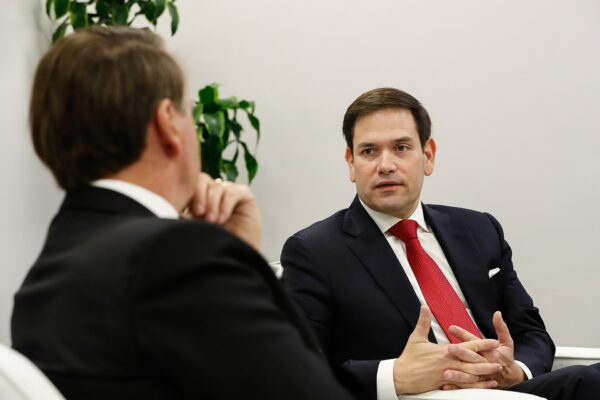
Secretary of State Marco Rubio pushed back forcefully Friday when pressed by reporters about how a ceasefire with Iran could still be considered intact following an exchange of fire that included U.S. missile strikes on a port city the day before.
Rubio framed the situation as a matter of basic self-defense, arguing that the U.S. response was necessary after American naval vessels came under attack. According to the secretary, U.S. destroyers operating in international waters were fired upon by Iranian forces, prompting a defensive reaction.
“What you saw yesterday was U.S. destroyers moving through international waters, being fired upon by the Iranians, and the U.S. responded defensively to protect itself,” Rubio said. He emphasized that the incident was separate from what he referred to as Operation Epic Fury, underscoring that the exchange did not represent a broader escalation beyond the immediate threat.
Rubio’s remarks reflected a hardline stance that, in his view, leaves little room for hesitation when American forces are targeted. “If you fire a drone or a missile at our destroyer, what are we supposed to do, let it hit?” he asked, insisting that the U.S. had no choice but to intercept the incoming threat and strike whatever launched it. Failing to act, he suggested, would risk the loss of a U.S. ship—an outcome he described as unacceptable.
The exchange with reporters grew tense when one journalist questioned whether the continued firing undermines the notion of a ceasefire. Rubio quickly cut in, redirecting the question toward Iran.
“Well, you should ask that of the Iranians,” he said sharply, adding that the U.S. did not initiate the confrontation. He went on to argue that expecting restraint under such circumstances would be unrealistic, dismissing the suggestion that the U.S. should hold fire simply because a ceasefire is in place.
“Don’t ask me—we didn’t fire, they fired on us,” Rubio said, rejecting the premise of the question outright. He argued that any nation faced with an attack on its military assets would be expected to respond in kind, describing alternatives as impractical.
The sharp tone underscored the broader challenge of maintaining a ceasefire in an environment where even limited engagements can quickly blur the line between defense and escalation. While officials continue to insist the ceasefire remains in effect, the exchange highlights how fragile such arrangements can be when tensions remain high.
Meanwhile, ABC News correspondent Rachel Scott spoke with President Donald Trump following the strikes. According to Scott, Trump downplayed the U.S. response, referring to it as a “love tap” during a phone conversation.
When asked whether the strikes signaled the end of the ceasefire, Trump dismissed the idea. “No, no, the ceasefire is going. It’s in effect,” he said, maintaining that the broader agreement remains intact despite the exchange.
The differing tones—from Rubio’s blunt defense of military action to Trump’s more dismissive characterization—highlight the delicate balancing act facing U.S. leadership. On one hand, officials stress the need to protect American forces without hesitation. On the other, they continue to insist that a ceasefire still holds, even as incidents like this raise questions about how durable such agreements can be when conflict continues to simmer just beneath the surface.
[READ MORE: Trump Downplays Hantavirus Concerns as Cruise Ship Outbreak Raises Questions]