Black Democrats on Capitol Hill are intensifying calls for Black high school athletes to boycott major Southern state universities, arguing that schools benefiting from elite athletic talent have remained silent while Republican-led states redraw congressional maps that eliminate majority-Black districts.
Led by the Congressional Black Caucus, lawmakers joined forces with the NAACP and other advocacy groups to pressure universities in the powerful Southeastern Conference to publicly oppose Republican-backed redistricting efforts across the South.
The strategy is straightforward: deny top-tier athletic programs the Black talent that helps fuel their success and financial power until those institutions speak out.
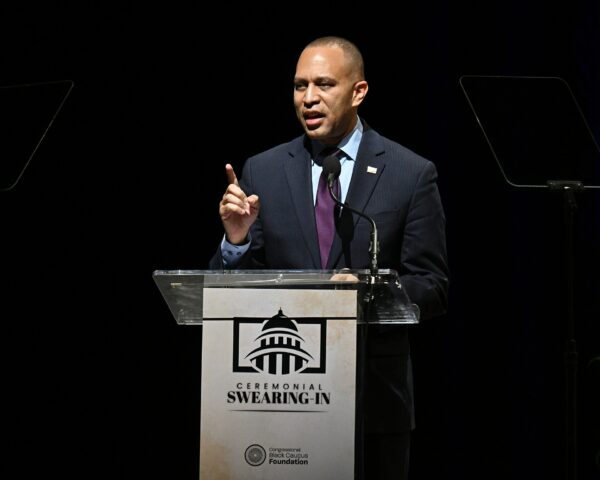
House Minority Leader Hakeem Jeffries described the moment as extraordinary, arguing that the political fight surrounding congressional redistricting requires an aggressive response.
“This is an unprecedented moment, featuring an unprecedented attack on Black political representation, and therefore it requires an unprecedented response,” Jeffries said Tuesday during a press conference outside the Capitol.
Jeffries accused Southern states of using tactics reminiscent of the Jim Crow era and criticized universities for what he called silence in the face of those changes.
“We are here standing in solidarity with NAACP in its call for athletes to boycott institutions within the SEC that belong to states that have unleashed these Jim Crow-like racially oppressive tactics,” he said. “And we believe that the silence of these institutions is complicity.”
The political pressure campaign comes as Black Democrats celebrate their role in helping derail a House vote on the SCORE Act, a bipartisan bill backed by the National Collegiate Athletic Association aimed at establishing national standards for compensating college athletes.
The legislation had been expected to reach the House floor this week, but opposition from Democrats intensified following a recent Supreme Court ruling limiting racial considerations in redistricting. That ruling prompted several Southern states to redraw congressional maps in ways Democrats argue weaken Black political representation and threaten Democratic-held districts.
According to lawmakers, resistance from Black Democrats was one factor in Republican leaders’ decision to postpone the vote on the athlete compensation measure.
Yvette Clarke, chair of the Congressional Black Caucus, framed the standoff as a broader moral and political test for American institutions.
“The Congressional Black Caucus cannot support legislation benefiting major athletic institutions that continue to remain silent while Black voting rights and Black political power are being systematically dismantled across the South,” Clarke said.
Democrats specifically targeted several powerhouse athletic programs located in states involved in ongoing redistricting battles. Those schools include Louisiana State University, University of Florida, University of Mississippi, University of Alabama, Auburn University and University of Tennessee.
“If the SEC schools are for it, we are against it,” Jeffries said, while also insisting universities should speak up “because it’s the right thing to do.”
Jeffries invoked prominent Black athletes and activists of previous generations, including Bill Russell, Muhammad Ali and Jackie Robinson, encouraging today’s recruits to consider the broader political climate when deciding where to attend school.
The long-term impact of the boycott push remains unclear, especially given the enormous cultural and financial influence of SEC athletics. But Clarke warned that the campaign could eventually expand beyond universities if institutions continue avoiding involvement in the redistricting debate.
“Silence from our institutions in moments of injustice carries consequences,” she said.
The escalating clash also reflects how America’s cultural and political battles are increasingly spilling into sports, higher education and other traditionally nonpolitical institutions. While lawmakers frame the effort as a fight for representation, the growing pressure on universities and athletes highlights how deeply national political divisions now reach into nearly every corner of public life.
[READ MORE: Justice Department Deal Halts Trump Family Tax Audits, Drawing Legal Scrutiny]