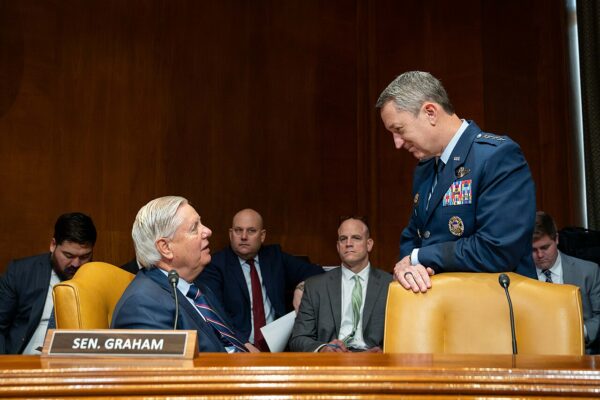
Sen. Lindsey Graham, R-S.C., expressed cautious optimism Sunday following President Donald Trump’s announcement that the United States and Iran have reached an agreement aimed at reopening the Strait of Hormuz and moving toward a broader resolution of tensions between the two countries.
While welcoming the reported breakthrough, Graham signaled that significant questions remain about how each side interprets the agreement and what the final terms will ultimately include.
“I am pleased to hear the memorandum of understanding with Iran to allow the Strait of Hormuz to open has been agreed to,” Graham wrote on X. “I will be watching closely the ensuing negotiations regarding Iran’s nuclear program and other matters.”
The South Carolina senator, who has long taken a hard-line stance toward Iran, said he is concerned that public statements from Tehran appear to differ from the description of the agreement provided by American negotiators.
“I am somewhat concerned that Iran’s view of the agreement seems different than what the American negotiating team is claiming,” Graham added.
Trump announced the agreement earlier Sunday, presenting it as a major development that could bring an end to the three-and-a-half-month conflict involving the Islamic Republic.
“The Deal with the Islamic Republic of Iran is now complete,” Trump wrote on Truth Social. He also announced that the Strait of Hormuz would be reopened to international shipping and that the United States would immediately remove its naval blockade of Iranian ports.
“I hereby fully authorize the toll free opening of the Strait of Hormuz, and, simultaneously herewith, authorize the immediate removal of the United States Naval blockade,” Trump wrote.
The Strait of Hormuz has remained a focal point of the conflict since the early stages of the war. Iranian restrictions on shipping traffic through the strategic waterway disrupted energy markets and contributed to rising gasoline prices in the United States. In response, the United States imposed a naval blockade of Iranian ports beginning in mid-April.
Details of the proposed agreement continue to emerge. According to Reuters, a senior Iranian official said a draft memorandum of understanding calls for the United States to refrain from imposing new sanctions on Iran while negotiations continue toward a final agreement. The official also said the proposal includes the release of $25 billion in frozen Iranian assets.
In exchange, Iran would reportedly agree not to produce or acquire nuclear weapons and would refrain from further uranium enrichment and expansion of its nuclear facilities.
The agreement’s next major milestone is expected to come Friday in Switzerland. Pakistani Prime Minister Shehbaz Sharif, who served as a mediator during the negotiations, said an official signing ceremony is planned there.
Vice President JD Vance told Fox News on Sunday that he intends to travel to Switzerland for the ceremony and said it is possible that Trump could attend as well.
As attention shifts from the announced framework to the details of a final accord, Graham emphasized that Congress should play a central role in evaluating any completed agreement.
“Any nuclear deal with Iran will be sent to Congress for review and a vote,” he said.
Graham also said he wants Vance and the negotiating team to participate directly in presenting the agreement to lawmakers.
“I look forward to reviewing the final product and I believe it is imperative that the architect of the deal, Vice President Vance and his negotiating partners, be part of the process in presenting the final deal to Congress,” he wrote.
For now, Graham offered congratulations to those involved in reaching the current stage of negotiations while stressing that the ultimate success of the agreement remains uncertain.
“Congratulations to all in getting us to this point,” Graham said. “Time will tell.”
[READ MORE: Trump Enemies Targeting His Age]