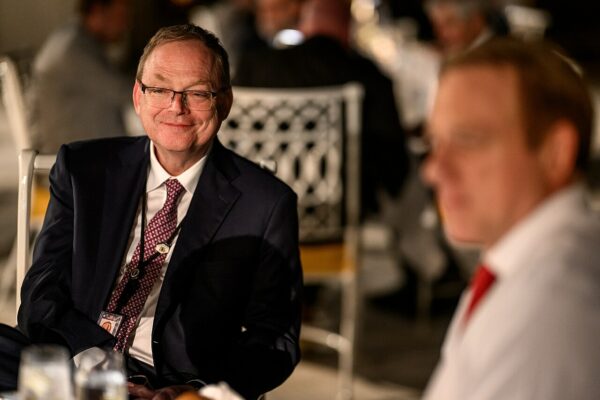
National Economic Council Director Kevin Hassett said Friday that stronger-than-expected factory construction and increased imports of capital goods played a key role in lowering the nation’s latest economic growth figure, arguing that underlying economic indicators remain strong.
Hassett made the remarks during an appearance on Fox Business Network’s “Mornings With Maria,” where he discussed the latest U.S. economic data with host Maria Bartiromo.
Bartiromo opened the interview by pointing to the latest economic reports, noting that corporate earnings had remained solid during the second quarter but that the nation’s gross domestic product came in below expectations. She also reminded Hassett that during a previous appearance, he had predicted economic growth of about 4% during the second half of the year.
Referencing the newly released GDP figures, Bartiromo asked Hassett how he viewed the current economic picture after growth came in lower than many analysts had anticipated.
Hassett responded by arguing that domestic demand largely matched what he had previously forecast.
“I think that what we are looking at when you and I talked last was the really surging domestic demand,” Hassett said, adding that final sales within the United States came in at roughly 3.9%, which he said was nearly identical to the 4% figure he had previously discussed.
According to Hassett, the headline GDP number of 1.5% reflected a surge in imports tied to business investment rather than weakness in the broader economy.
He said the United States imported a significant amount of capital goods because businesses are “building factories so fast,” which he argued accounted for much of the difference between the expected and reported growth figures.
Hassett maintained that the increase in capital spending should be viewed as a positive development, saying it contributes to greater productive capacity and helps ease inflationary pressures over time.
He argued that increased supply resulting from factory construction places downward pressure on inflation while supporting long-term economic growth.
Hassett also pointed to recent inflation reports as evidence that the economy remains in solid shape.
He said both the Consumer Price Index (CPI) and the Personal Consumption Expenditures (PCE) reports were about as favorable as Federal Reserve officials could hope to see, adding that the data suggested the economy is “really running on all cylinders.”
Beyond inflation, Hassett highlighted labor market data as another indicator of economic strength.
He said new claims for unemployment insurance had fallen to their lowest levels since the 1960s, emphasizing that today’s labor force is substantially larger than it was during that decade.
According to Hassett, reaching claims levels comparable to those seen in the 1960s despite a much larger workforce is another sign that the economy remains healthy.
The Friday appearance marked the latest in a series of television interviews in which Hassett has made notable comments on economic and geopolitical issues.
According to the article, he has previously attributed issues in the Strait of Hormuz to “guys living in caves,” defended President Donald Trump’s pledge to lower gasoline prices despite U.S. strikes on Iran by describing the promise as “realistic,” and said earlier this week that the “economy really does look amazing to me.”
During his latest interview, however, Hassett focused primarily on explaining why headline GDP growth came in below expectations while maintaining that stronger domestic demand, increased capital investment and favorable inflation and labor data point to what he described as a fundamentally strong U.S. economy.
[READ MORE: Vivek Ramaswamy Booed Off Stage at Libertarian Convention During Ohio Campaign Speech]