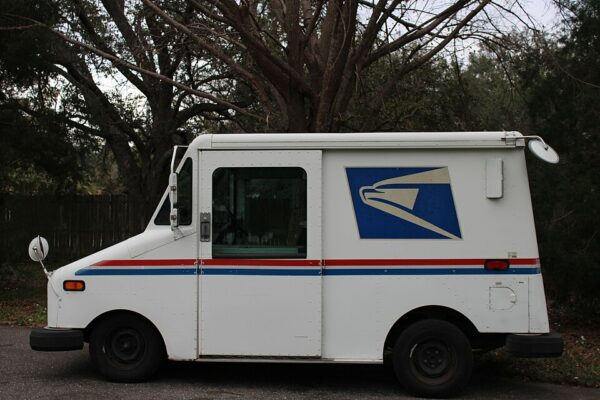
President Donald Trump has moved to place the U.S. Postal Service at the center of a new federal effort to tighten mail-in voting rules, escalating a fight that has repeatedly turned the post office into a political flashpoint for Democrats, voting-rights groups, postal unions, and conservative election-integrity advocates.
In a March executive order, Trump directed the Postal Service to work with states on verifying who is eligible to receive absentee ballots and to stop delivering ballots to people who are not on approved lists. The order would mark a sharp expansion of the agency’s role, shifting it from a neutral carrier of election mail into a participant in enforcing ballot eligibility rules.
The move has already drawn lawsuits and internal concern at USPS, where officials face questions about whether the financially strained agency has the authority, personnel, and infrastructure to carry out such a mandate, according to CNN.
Sources inside the Postal Service told reporters that officials are alarmed about assuming such a contentious responsibility, especially as the agency seeks congressional and White House support to address its long-running financial problems.
The order also lands in the middle of a broader political dispute over mail voting. Conservatives have argued for years that absentee voting creates security risks because ballots are cast outside the controlled environment of polling places. A White House fact sheet on Trump’s order said the USPS would transmit ballots only to voters on state-specific absentee and mail-in participation lists, with ballots sent in secure envelopes marked as “Official Election Mail” and equipped with unique tracking barcodes.
“We want to have honest voting in our country, because if you don’t have honest voting, you can’t have, really a nation if you want to know the truth,” Trump said after signing the document in the Oval Office.
Democrats and liberal groups have responded with familiar alarm. Since 2020, when Trump first clashed with Democrats over expanded mail voting during the Covid-19 pandemic, the Postal Service has become a recurring symbol in the left’s broader fear that Republicans are using administrative changes to restrict voting. That fight helped turn routine postal operations into a national political controversy, with Democrats frequently warning that changes at USPS could affect ballot delivery and election access.
Voting-rights organizations and several Democratic-led states now argue that Trump’s latest order crosses constitutional boundaries because states hold primary responsibility for election administration.
“USPS is no longer merely a carrier of ballots; it is instead transformed into a gatekeeper of voter eligibility,” lawyers challenging the order wrote.
Despite pending lawsuits, the order requires the Postal Service to begin its rulemaking process by the end of May. The agency has confirmed that it has started that work, though current and former officials have questioned whether it can realistically implement such a broad new mandate or whether its independent board may resist any attempt to secure the election.
The agency is attempting to comply while avoiding direct conflict with the administration or Congress, according to people familiar with internal discussions.
The development continues a fight dating back to 2020, when Trump objected to expanded mail-in voting during the pandemic. With the Supreme Court now considering rules on late-arriving ballots, the president is again seeking to shape mail-voting procedures, this time by involving the Postal Service directly.
The March directive calls for federal agencies to create “state citizenship lists” using data from sources such as Social Security and immigration records. It urges states to compare voter rolls against those lists and remove people flagged as ineligible. The Postal Service would then help enforce a restricted list of approved mail-in voters, refusing to deliver ballots outside that list.
The goal, according to a White House official, is to ensure mail ballots reach only eligible voters.
“Absentee ballots do not currently abide by the same secure processes that exist for in-person voting, and the USPS rule will fix that,” the official said.
Critics counter that there is no evidence of widespread fraud in mail voting and warn that the policy would improperly position the Postal Service as an election enforcer.
The order also introduces potential criminal penalties for delivering ballots to ineligible voters, raising concerns among postal unions that workers could be drawn into policing voter eligibility.
“We are frankly very skeptical about our ability to even do this effectively,” National Association of Letter Carriers President Brian Renfroe told CNN. “I’m very concerned about where this road leads.”
Multiple lawsuits to prevent the security measure have popped up from Democratic-led states, lawmakers, and voting-rights groups are now underway, of course.
For Trump, the order reflects a familiar argument: mail ballots should be subject to stricter safeguards before they enter the election system. For Democrats and liberal voting groups, verifying that only citizens are voting threatens their power.