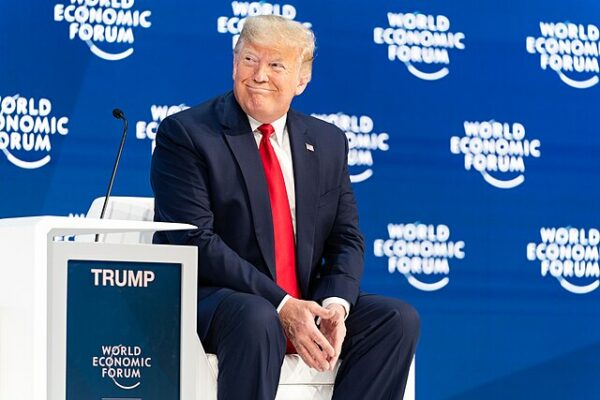
President Donald Trump offered a striking description of the suspect who charged through security at the White House Correspondents’ Association dinner, calling the gunman a “blur” and even joking that the NFL “should sign him up” for his speed.
Speaking in an interview with Norah O’Donnell on 60 Minutes, Trump reflected on the chaotic moments that unfolded Saturday night at the Washington Hilton, where a heavily armed individual rushed past security and exchanged gunfire with law enforcement before being taken into custody.
“His speed was rather incredible,” Trump said. “It was like a blur.” He went on to remark that, based on what he had seen, the suspect moved so quickly that it was difficult to fully process in real time. “I think the NFL should sign him up,” he added, injecting a note of levity into an otherwise serious situation.
O’Donnell pressed the president on a question that has been raised repeatedly since the incident: how was the suspect able to get so close in a venue described as being heavily secured?
Trump responded by voicing strong support for law enforcement, while also acknowledging the challenges they face. He suggested that individuals who carry out such acts may be unstable, but are often capable of planning and exploiting vulnerabilities. According to the president, the suspect ran approximately 45 yards and managed to push forward quickly before being stopped.
The incident disrupted what had been intended as a high-profile evening celebrating free speech and political humor. Instead, it turned into a tense and dangerous situation as security personnel moved to contain the threat and protect those in attendance, including top administration officials.
Authorities and media reports have identified the suspect as Cole Allen of Torrance, California. According to the White House, the individual was likely targeting the president and other senior members of the administration.
White House press secretary Karoline Leavitt condemned the attack in strong terms, describing the suspect as a “depraved crazy person” who sought to assassinate the president and inflict as much harm as possible. In a post on X, she noted that what was meant to be a lighthearted and celebratory event was instead overtaken by violence.
Even as Trump praised the quick response of law enforcement, the incident has left behind difficult questions about security preparedness in environments where political leaders, media figures, and public attention converge. The president’s comments highlighted both the speed of the attacker and the equally rapid reaction from those tasked with stopping him.
Moments like these often reveal a dual reality: the professionalism and courage of those on the front lines, and the persistent vulnerabilities that can still be exploited. While the suspect was ultimately apprehended, the fact that he was able to advance as far as he did underscores the complexity of securing large, high-profile gatherings.
As the investigation continues, the focus remains on understanding how the breach occurred and whether existing measures are sufficient. In the meantime, the incident serves as another reminder that even events centered on dialogue and public life are not immune from the broader tensions shaping the current moment—where security concerns increasingly intersect with the realities of political and global conflict.