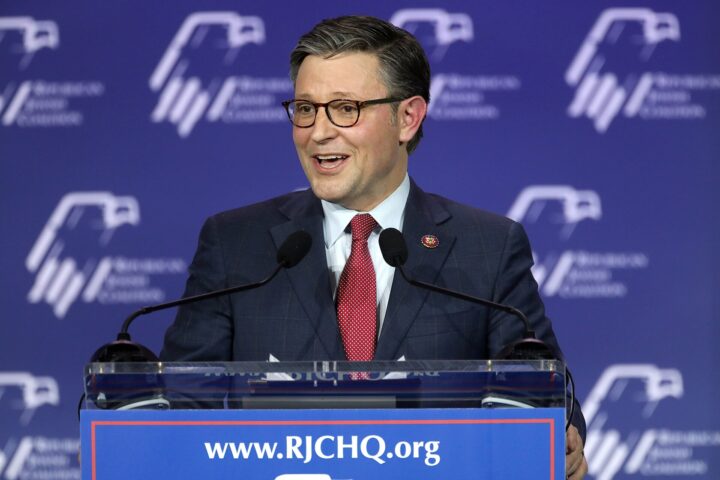
House Speaker Mike Johnson is pointing to political rhetoric as a contributing factor in the wake of the White House Correspondents’ Dinner shooting, accusing Democratic lawmakers of “inciting violence” while urging a broader reset in tone during an already tense moment for the country.
Appearing Monday on America’s Newsroom with Bill Hemmer, Johnson addressed the incident that unfolded Saturday night at the Washington Hilton, where journalists and Trump administration officials had gathered for the annual dinner. The event, typically a celebration of the First Amendment, instead became the scene of a dangerous security breach that has sparked renewed debate over both safety and the political climate.
Hemmer referenced remarks made by Sen. John Fetterman, who had called for setting aside partisan divisions and building a White House ballroom better suited to hosting events involving top government officials. Fetterman’s comments stood out in the immediate aftermath of the shooting, drawing attention from both sides of the aisle.
Asked whether he was hearing similar sentiments from other Democrats, Johnson was blunt. “No,” he said, describing Fetterman as a “rare voice” and suggesting that more lawmakers should adopt a similar tone. In contrast, Johnson argued that some Democratic figures have contributed to a more volatile environment through their language.
According to Johnson, the use of aggressive metaphors—particularly those invoking conflict or war—can have unintended consequences. He warned that such rhetoric may resonate with unstable individuals, especially in an era where messages spread rapidly online and can contribute to radicalization.
“We’ve got to recognize that,” Johnson said, calling for a collective effort to “turn down the rhetoric.” He framed the moment as an opportunity for reflection, suggesting that the weekend’s events should serve as a warning about the potential impact of political language.
At the same time, Johnson expressed support for the idea of constructing a White House ballroom, echoing a point that has gained traction among supporters of President Donald Trump. He argued that such a facility could provide a more secure setting for large gatherings involving senior officials, noting that it would be located on highly protected grounds and built with enhanced security features.
Johnson described the proposed ballroom as a long-needed solution, emphasizing its potential to offer a controlled environment without some of the vulnerabilities associated with private venues like hotels. However, he acknowledged that the White House Correspondents’ Dinner itself is not a government-run event, but rather organized by the White House Correspondents’ Association, meaning it would not necessarily be held on White House grounds even if the ballroom were completed.
Still, the incident has intensified calls from Trump and his supporters to move forward with the project, including dropping legal challenges that have delayed construction. For many, the shooting has become a rallying point in a broader conversation about how best to protect national leaders in an increasingly uncertain environment.
Yet beneath the policy debates and political disagreements lies a deeper concern. While proposals for stronger security and more controlled venues continue to gain attention, Johnson’s remarks also highlight the role of tone and rhetoric in shaping the national atmosphere. In a climate where words can carry real consequences, the challenge is not only how to safeguard public figures—but how to reduce the tensions that make such threats more likely in the first place.
[READ MORE: Trump Describes WHCA Gunman as ‘Blur,’ Praises Law Enforcement While Questions Linger]