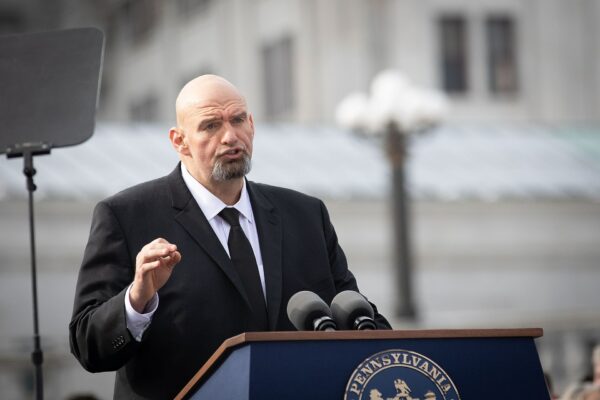
In a rare moment of bipartisan alignment, Sen. John Fetterman is now reportedly joining voices on the right in calling for the construction of a White House ballroom following the shooting at Saturday night’s White House Correspondents’ Dinner—an incident that has renewed scrutiny over how the nation protects its top leaders.
Fetterman, who attended the event at the Washington Hilton alongside President Donald Trump, the vice president, members of the Cabinet, and lawmakers from both parties, described the situation as deeply concerning given the number of high-ranking officials gathered in one place.
“We were there front and center,” Fetterman wrote after the incident. He argued that the venue itself was not designed to handle an event involving so many individuals in the presidential line of succession, raising serious questions about whether the setting was appropriate in the first place. His conclusion was direct: set aside partisan divisions and move forward with building a ballroom capable of hosting such high-stakes gatherings more securely.
The Pennsylvania Democrat’s remarks echo a growing chorus of MAGA-aligned figures who have seized on the incident as evidence that President Trump’s long-discussed ballroom project is not just a luxury, but a necessity. Supporters argue that a purpose-built space on White House grounds—potentially including a secure basement bunker—could help prevent future security breakdowns like the one witnessed over the weekend.
Fetterman amplified concerns about the venue’s preparedness by sharing commentary from Joe DePaolo, who sharply criticized the level of security at the event. DePaolo described the measures in place as “downright awful,” noting that he had serious doubts about their adequacy even before the shooting occurred. Those concerns, he said, were confirmed when the situation escalated shortly afterward.
Despite the heightened attention, it’s worth noting that the White House Correspondents’ Dinner is not an official government event, complicating the question of responsibility for security. Still, critics argue that when so many top officials are present, the distinction may matter less than the outcome.
Prominent conservatives, including Rep. Randy Fine, Rep. Tim Burchett, commentator Jack Posobiec, and Meghan McCain, have all suggested that a White House ballroom could have changed the circumstances surrounding the incident. Their argument centers on the idea that a controlled, government-managed environment would offer stronger safeguards than a private venue.
President Trump himself leaned into that argument during a hastily arranged press conference Saturday night, saying the incident underscored the need for the ballroom project. He later reinforced the point on Truth Social, claiming that such an event “would never have happened” if the proposed facility were already in place and operational.
But the project remains mired in controversy. After the administration moved forward with demolishing the East Wing of the White House last October without full vetting, preservation groups, including the National Trust for Historic Preservation, filed a lawsuit to halt construction. A federal judge subsequently ordered the project paused, ruling that the administration must first obtain explicit authorization from Congress before proceeding.
The debate now unfolding goes beyond architecture. It touches on a broader tension between security and process—how far the government should go to protect its leaders, and at what cost to established norms and oversight. As calls for stronger protections grow louder, the challenge will be ensuring that urgency does not override accountability, even in moments shaped by fear and uncertainty.