President Donald Trump escalated his criticism of House Minority Leader Hakeem Jeffries on Thursday, calling for the Democratic lawmaker to be “charged with INCITING VIOLENCE” in a fiery post on Truth Social. The remarks come in the wake of the April shooting incident at the White House Correspondents’ Dinner, which has continued to stir political tensions in Washington.
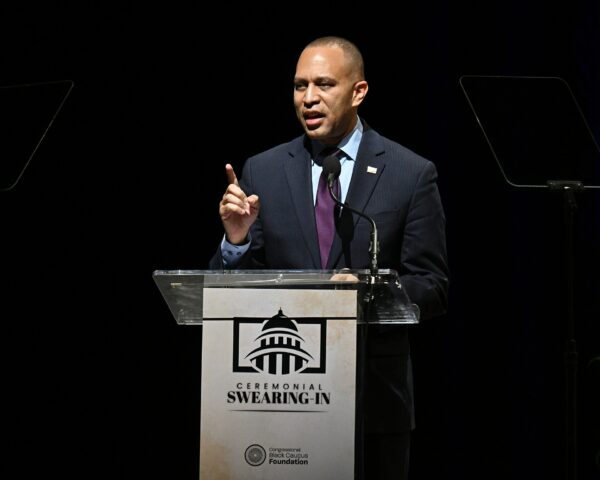
In his post, Trump shared a meme that juxtaposed two images: a CCTV still capturing the moment shooting suspect Allen Cole rushed a Secret Service checkpoint during the event, and a photo of Jeffries speaking at a press conference just days earlier on April 21. During that appearance, Jeffries stood beside a poster displaying Trump’s face alongside the phrase “Maximum warfare everywhere all the time.”
Trump seized on the imagery to argue that Jeffries’ rhetoric may have contributed to a broader climate of hostility. In his caption, the president referred to Jeffries as a “lunatic” and accused “Radical Left Democrats” of wanting to “Destroy our Country,” underscoring the increasingly sharp tone dominating political discourse.
The controversy surrounding Jeffries’ remarks is not new. Following criticism from Republican lawmakers after the White House Correspondents’ Dinner incident, Jeffries addressed the issue publicly during a press conference held two days later. He dismissed the backlash, stating he did not care about the criticism and defended the phrase as originating from a source quote in a 2025 New York Times article. According to Jeffries, the language was used in the context of describing political battles over congressional redistricting, not as a literal call to action.
Still, the episode has added fuel to an already heated political environment, where rhetoric on both sides is increasingly scrutinized for its potential real-world consequences. Trump’s latest comments also follow earlier remarks this week in which he questioned why Jeffries had not faced impeachment after the Democrat criticized the Supreme Court. Jeffries had labeled the Court “illegitimate” in response to its ruling that race-based gerrymandering violates the Voting Rights Act of 1965.
The back-and-forth highlights the deep divisions in Washington, where disputes over policy and language often spill into broader accusations about intent and responsibility. While political leaders routinely engage in forceful messaging, moments like this raise questions about how such rhetoric is interpreted—especially in times marked by heightened tensions and isolated acts of violence.
At the center of the debate is the challenge of balancing strong political expression with the responsibility that comes with public influence. As the fallout from the April incident continues, the focus remains not only on the individuals involved, but also on the tone set by those in positions of power.
[READ MORE: Trump Pauses Strait of Hormuz Mission After Saudi Arabia Withholds Military Access]