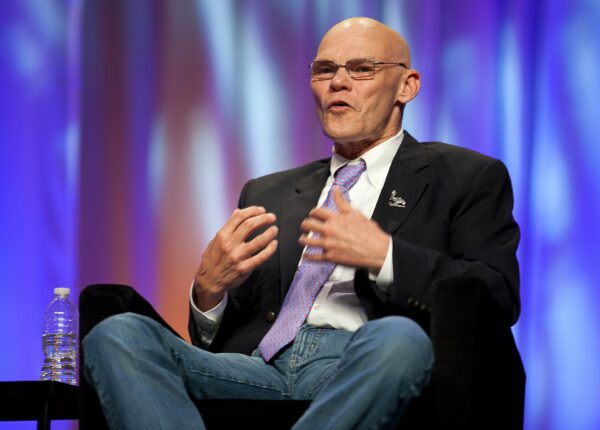
President Donald Trump sharply criticized Democratic strategist James Carville, escalating an already heated political battle over the future of the Supreme Court and the balance of power in Washington.
In a series of remarks posted Tuesday night on Truth Social, Trump labeled Carville among the “sleazebags” he says are encouraging Democrats to take an aggressive approach against Republicans. The comments came in response to Carville’s calls for sweeping structural changes, including expanding the number of justices on the Supreme Court to 13 and granting statehood to Puerto Rico and Washington, D.C.
The debate over the court’s size is not new, but it remains deeply contentious. Conservatives currently hold a 6-3 majority on the bench, and while the Constitution does not fix the number of justices, it has remained unchanged since 1869. Proposals to expand the court are often framed by critics as an attempt to shift its ideological balance rather than a neutral reform.
Trump framed the issue in stark terms, warning that such moves could have long-lasting consequences for the country’s political landscape. He argued that adding states like Puerto Rico and Washington, D.C. would tilt power toward Democrats for generations, describing the proposals as a threat to the nation’s future.
At the same time, Trump renewed his call for Senate Republicans to eliminate the filibuster, the procedural rule that allows a minority of 41 senators to block most legislation. His push reflects growing frustration among some conservatives who see the rule as an obstacle to advancing key priorities, even as it has historically served as a tool for both parties.
In his remarks, Trump also took aim at the Supreme Court itself, offering a mixed critique of its current composition. While acknowledging that the court has ruled in his favor more often than not, he expressed disappointment with certain Republican-appointed justices, accusing them of lacking unity and ideological consistency.
By contrast, Trump pointed to Democratic-appointed justices as being more cohesive, saying they remain “totally loyal” to the perspectives that brought them to the bench. He suggested that some conservative justices place too much emphasis on appearing independent or politically neutral, rather than adhering closely to the views associated with their appointments.
The president cited specific issues to illustrate his concerns, including birthright citizenship and tariff-related rulings. He argued that decisions in these areas have had significant consequences, including what he described as financial costs to American taxpayers. In one example, he claimed that a different ruling on tariffs could have prevented the return of substantial funds.
Underlying the back-and-forth is a broader struggle over how power is exercised in Washington. Calls to reshape institutions like the Supreme Court or the Senate rules reflect a growing willingness on both sides to consider dramatic changes in pursuit of political goals.
Carville, for his part, has not held back in his criticism of Trump. Earlier this month, he delivered a blunt and profane message directed at the president, underscoring the deeply personal tone that has come to define much of today’s political discourse.
As both sides dig in, the clash highlights not only the high stakes surrounding the Supreme Court, but also the increasingly combative nature of American politics. While leaders continue to push for advantage, the intensity of the rhetoric suggests a system under strain—where institutional changes are no longer theoretical, but actively being debated as tools in an ongoing political fight.
[READ MORE: Ukraine Considers Naming Area After Donald Trump]