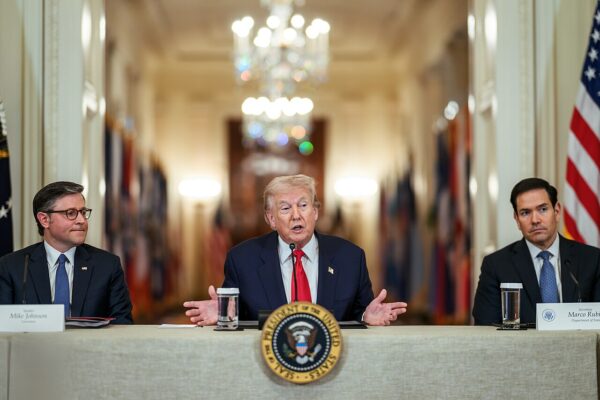
President Donald Trump made clear Friday that negotiations with Iran remain unresolved, telling reporters he is not satisfied with the latest proposal as he departed the White House for Florida.
Speaking on the South Lawn, Trump took several questions about the ongoing talks, offering a candid assessment of where things stand. When asked about a new Iranian proposal, the president acknowledged that Tehran appears eager to strike a deal—but said the terms on the table do not meet his expectations.
“They want to make a deal, but I’m not satisfied with it,” Trump said, leaving open the possibility of further negotiations while signaling that any agreement would need to change significantly before earning his approval.
Trump also offered a blunt evaluation of Iran’s current position, suggesting the country is negotiating from a weakened state. He said Iran “has no military left, essentially,” and emphasized that its leadership appears motivated to reach an agreement, even as internal divisions complicate the process.
Those divisions, according to the president, are a major obstacle. Trump described Iran’s leadership as fractured, with multiple competing factions struggling to align on a single path forward. “It’s a very disjointed leadership,” he said, noting that while different groups may all want a deal, they are not unified in how to achieve one.
The remarks reflect a broader theme that has defined the administration’s approach: a willingness to negotiate, paired with skepticism about whether a durable agreement can be reached under current conditions.
Trump was also pressed on whether he would seek congressional approval for the ongoing conflict. His response pointed to longstanding precedent, arguing that such authorization has historically not been pursued in similar situations.
“It’s never been sought before,” Trump said, adding that while his administration remains in contact with Congress, formal approval has not traditionally been part of the process. The comment underscores the ongoing debate in Washington over the role of Congress in matters of war and military engagement—a question that has resurfaced repeatedly during periods of international tension.
Another question turned to diplomacy beyond the immediate U.S.-Iran channel, specifically whether the administration would send officials to Islamabad for further talks. Trump responded by expressing respect for Pakistan’s leadership and confirming that the country continues to play a role in ongoing discussions.
At the same time, he indicated that much of the current negotiation effort is being conducted remotely. The logistical challenges of travel, combined with the pace of developments, have kept talks largely telephonic for now, though Trump noted that some progress has been made.
Still, the president’s overall tone suggested caution rather than optimism. While acknowledging that Iran has taken steps toward a potential agreement, he repeatedly emphasized uncertainty about whether those efforts will ultimately lead to a deal.
The situation highlights the delicate balance facing U.S. leadership: pursuing diplomacy while maintaining leverage, and weighing the risks of prolonged conflict against the challenges of reaching a meaningful resolution. Even as negotiations continue, the absence of a satisfactory agreement serves as a reminder that, in moments like this, the path forward is rarely straightforward—and the stakes remain high.
[READ MORE: Powell’s Plan to Stay at Fed Sparks Backlash, Raises Questions About Policy Direction]