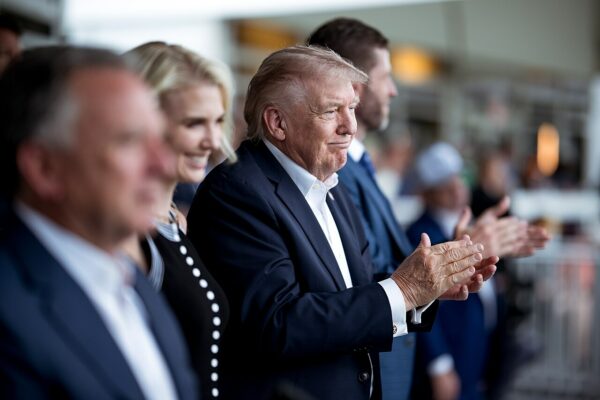
President Donald Trump reportedly signed a new executive order Monday establishing moms.gov, a federal website designed to provide additional resources for expectant mothers. The announcement, made from the Oval Office, was framed as part of a broader effort to support maternal health, though the event also quickly turned into a familiar back-and-forth with the press.
While highlighting the new initiative, Trump pivoted to one of his longstanding policy priorities: lowering prescription drug costs. The president argued that his administration has made significant strides in reducing prices, claiming cuts ranging from 50% to as high as 80%. At the same time, he sharply criticized the media, accusing major outlets of downplaying or ignoring those efforts.
“The media, they don’t want to write about it,” Trump said, suggesting that coverage has been shaped more by bias than by the scope of the policy itself. He described the lack of attention as “amazing” and “sad,” and pointed to what he claimed were declining approval ratings for the press. His remarks drew laughter from aides and supporters gathered for the event.
Trump went on to argue that media skepticism has not translated into political weakness. He asserted that despite what he characterized as overwhelmingly negative coverage, he was still able to secure a decisive electoral victory. The president framed the issue as one of credibility, urging journalists to focus more closely on what he considers substantive policy achievements.
In reality, the push to lower prescription drug prices has received extensive coverage across a range of outlets, including The New York Times, MSNBC, and The Atlantic—publications the president has often criticized. Multiple reports have examined the administration’s proposals and promises on drug pricing, even as debate continues over their impact and feasibility.
Still, Trump showed no sign of backing away from his critique. He argued that political opposition in Washington has at times been driven less by policy disagreements and more by what he described as “Trump Derangement Syndrome,” a term he has frequently used to characterize his critics. According to the president, that dynamic has led some lawmakers to reflexively oppose initiatives tied to his administration, including funding related to maternal health care.
The president claimed that every Democrat in Congress voted against what he called historic funding in this area, attributing that opposition to partisan reflex rather than policy substance. He suggested that the current political climate has made it difficult to advance legislation on its merits.
In a moment of characteristic improvisation, Trump floated a tongue-in-cheek strategy for navigating that divide. He joked that he might begin proposing the opposite of what he actually wants, reasoning that such an approach could prompt critics to support the outcome he favors. The comment drew laughs but also underscored the deep polarization that continues to define debates in the nation’s capital.
As the administration rolls out moms.gov, the initiative itself is likely to receive attention as part of a broader conversation about maternal health resources. At the same time, the president’s remarks highlight an ongoing tension between policy messaging and media coverage, one that shows little sign of easing.
The event ultimately blended policy rollout with political theater, reflecting a familiar pattern in Washington. Even as new programs are introduced, the surrounding debate often shifts toward broader questions of trust, credibility, and the challenge of governing in an environment shaped by sharp divisions.