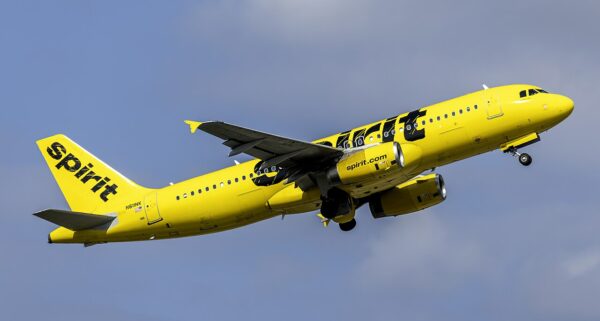
President Donald Trump on Thursday suggested the federal government could step in and purchase Spirit Airlines outright, then later sell it for a profit—an idea that signals a significant escalation in how his administration is approaching the struggling carrier’s financial troubles.
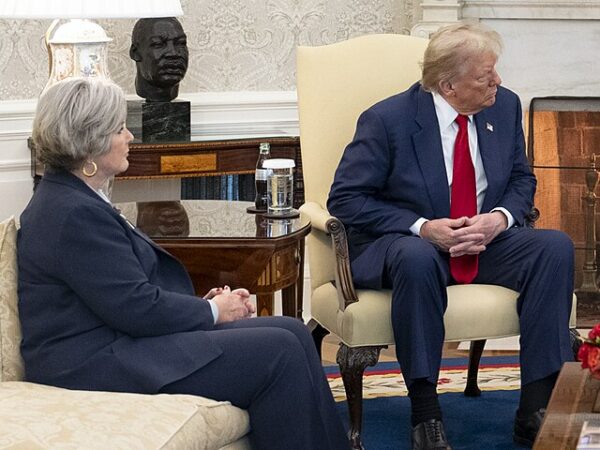
Speaking to reporters after an Oval Office meeting with Israeli and Lebanese officials, Trump was asked about reports that the administration might take a stake in the airline, which has faced multiple bankruptcy filings and rising costs. The president confirmed that intervention is under consideration, framing it as both a business opportunity and a way to preserve American jobs.
“So, Spirit is an airline that’s had some trouble,” Trump said, pointing to what he described as a missed opportunity years ago when a proposed merger involving the airline was blocked during the administration of former President Barack Obama. Trump argued that such a move would have been a “natural merger” and suggested its rejection hurt both companies involved.
Now, with the airline facing renewed financial strain, Trump indicated the federal government could take a more direct role. “We’re looking at helping them,” he said, before floating a more aggressive approach. “Or buying it. I think we just buy it.”
The president outlined a vision in which the government would acquire the airline at a low cost, noting it could be obtained “virtually debt free.” He pointed to the company’s aircraft, assets, and valuable airport slots as reasons the investment could pay off down the line—particularly if oil prices decline.
“When the price of oil goes down, we’ll sell it for a profit,” Trump said, adding that preserving jobs remains a key motivation. “I’d love to be able to save those jobs. I’d love to be able to save an airline.”
Trump emphasized that maintaining competition in the airline industry is important, arguing that a greater number of carriers benefits consumers. He also noted that the airline is currently in bankruptcy proceedings and that the administration is evaluating whether a deal could be struck at the “right price.”
“We have 18,000 people that live in this country that are great people and great employees,” Trump said, underscoring the human element behind the potential move. He also indicated that a qualified individual is ready to take over operations if the acquisition proceeds, suggesting confidence that the airline could be turned around under new leadership.
The proposal comes as the administration has already taken stakes in several private-sector companies, including a reported $8.9 billion investment in chipmaker Intel. Trump has defended such moves as consistent with a “very free market” philosophy, though critics—particularly among Republicans—have raised concerns about government involvement in private enterprise.
The idea of a federal purchase of an airline highlights a broader tension in economic policy: balancing free-market principles with intervention aimed at protecting jobs and stabilizing industries. While Trump’s proposal is framed as both pragmatic and potentially profitable, it also reflects the kind of extraordinary measures that can arise during periods of broader national strain, where economic pressures and global conflicts intersect.
As discussions continue, the question remains whether such an approach would ultimately strengthen competition—or signal a deeper shift in how far the government is willing to go in reshaping the private sector during uncertain times.
[READ MORE: Varney Flags Weak Polling for Trump as Questions Grow Over Government Performance]