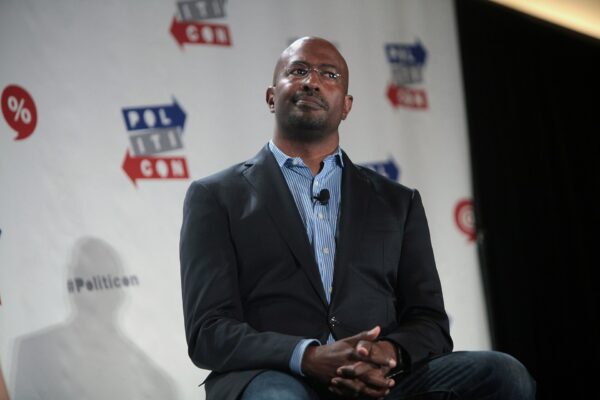
President Donald Trump sharply criticized CNN analyst Van Jones on Monday, accusing the former Obama administration official of ingratitude and calling on him to be “ashamed of himself” over his current commentary.
In a post on Truth Social, Trump recounted his role in helping advance criminal justice reform legislation, claiming that Jones once approached him in a moment of urgency, seeking assistance to secure the votes needed to pass the measure. Trump described the encounter in vivid terms, saying Jones had been “crying like a baby” while trying to push the effort forward alongside a group of African American leaders.
According to the president, the reform push had stalled before his involvement, with key conservative support lacking and little expectation of success. Trump said he ultimately stepped in to help “quickly round up the votes” necessary to move the legislation across the finish line, emphasizing that the effort was difficult and required persuading lawmakers who had not previously been on board.
He further argued that his intervention succeeded where others had failed, noting that prior attempts to pass similar reforms had not achieved the same result. Trump credited himself with delivering what “nobody else” could, portraying the episode as a clear example of his ability to navigate Washington’s gridlock and produce tangible outcomes.
The president’s remarks, however, quickly turned from reflection to frustration. He said that despite that collaboration, he now regularly sees Jones criticizing him and his administration on CNN. Trump pointed to Jones’ use of harsh language, including calling him a “dictator,” as evidence of what he views as a stark reversal.
“Now I watch this guy, Van Jones, every chance he gets, calling me a ‘Dictator,’ and far worse,” Trump wrote, adding that Jones “should be ashamed of himself.”
It remains unclear whether a specific recent CNN segment prompted Trump’s comments, but the exchange underscores the lingering tensions between political figures who once found common ground on a major policy initiative.
Jones played a visible role in supporting the 2018 passage of the First Step Act, a bipartisan effort aimed at improving outcomes within the federal prison system and reducing incarceration levels. The measure drew support from across the political spectrum and was seen at the time as a rare instance of cooperation in a deeply divided political environment.
Jones has frequently highlighted that period of collaboration, often pointing to Jared Kushner as a key figure in advancing the effort within the Trump administration. Kushner’s involvement, Jones has noted, was shaped in part by personal experience, including his father’s time in federal prison.
The renewed clash between Trump and Jones highlights how quickly political alliances can shift, even when built on shared legislative achievements. What was once a moment of bipartisan cooperation has now become a point of contention, with both sides framing the history in sharply different ways.
At its core, the dispute reflects a broader dynamic in Washington, where policy victories do not always translate into lasting political goodwill. Even when leaders from opposing camps come together to address issues like criminal justice reform, those agreements can prove fragile once the immediate goal has been achieved.
As the rhetoric intensifies, the episode serves as a reminder that collaboration, while possible, often exists within a narrow window — and can give way just as quickly to renewed division.
[READ MORE: Trump Announces New Phase In Iran]