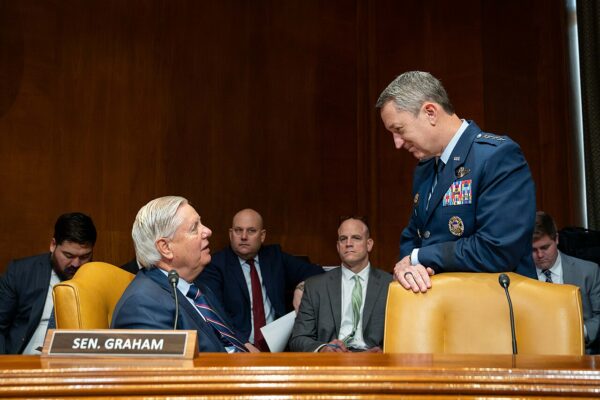
Senator Lindsey Graham delivered a fiery exchange on Capitol Hill Tuesday, openly challenging Defense Secretary Pete Hegseth and Joint Chiefs Chairman Dan Caine over troubling reports tied to the ongoing conflict involving Iran.
The tense moment unfolded during a budget hearing, where Graham pressed both officials about a report from CBS News alleging that Pakistan may be allowing Iranian military aircraft to land at its air bases. The report suggested the move could be an effort to shield those assets from potential U.S. strikes—an allegation that, if true, would raise serious questions about Islamabad’s role in the broader geopolitical landscape.
Graham wasted little time getting to the point. Addressing Caine directly, he asked whether the general was aware of the report. Caine acknowledged seeing a single report but stopped short of confirming its accuracy. That hesitation appeared to frustrate Graham, who continued pressing for clarity.
“Well, is it accurate?” Graham asked, seeking a definitive answer.
When a clear response did not come, the senator pivoted, posing a broader question about the implications. If Pakistan were indeed allowing Iranian aircraft to use its bases, Graham argued, it would directly conflict with its purported role as a mediator in peace negotiations.
Caine declined to weigh in on that hypothetical, prompting Graham to turn his attention to Hegseth. The defense secretary offered a cautious response, indicating he did not want to insert himself into ongoing diplomatic negotiations. But that restraint only seemed to escalate the senator’s frustration.
“Well, I do!” Graham shot back, cutting off Hegseth mid-response. His remarks underscored a deep skepticism toward Pakistan’s intentions, particularly in a moment where alliances and neutrality are under intense scrutiny.
Graham did not mince words, saying he does not trust Pakistan “as far as I can throw ’em.” He argued that if the report is accurate, it should prompt the United States to reconsider who it relies on to mediate sensitive talks involving Iran. In his view, such contradictions could help explain why diplomatic efforts appear stalled.
“No wonder this damn thing is going nowhere!” Graham exclaimed, voicing what sounded like broader frustration with the pace—and direction—of negotiations.
Despite the sharp criticism, the senator made clear that his concerns were not aimed at undermining U.S. leadership outright. He expressed appreciation for the efforts undertaken by defense officials, while simultaneously warning that certain international relationships deserve closer scrutiny.
“I appreciate all you’ve done. I’m very supportive of it,” Graham said, before adding a pointed critique of both Pakistan and China.
The exchange highlighted the growing tension not only on the battlefield but also in the diplomatic arena, where questions about trust, alliances, and strategy continue to complicate efforts to bring the conflict to a resolution. Even as military and political leaders navigate a complex web of relationships, moments like Tuesday’s hearing suggest that confidence in the process remains far from settled—and that frustrations are beginning to boil over.
[READ MORE: House Ethics Panel Expands Probe Into Rep. Cory Mills as Allegations Draw Scrutiny]