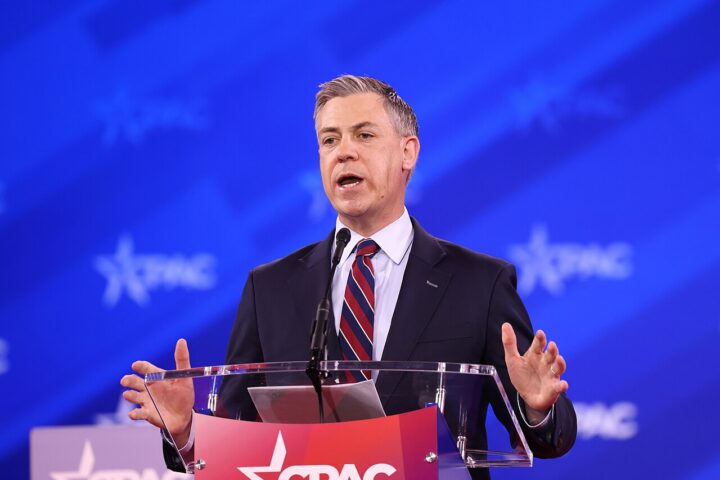
Sen. Jim Banks, R-Ind., introduced legislation Monday aimed at writing President Donald Trump’s Day One executive order on birthright citizenship into federal law, marking the latest Republican effort to reshape how citizenship is granted in the United States.
The Citizenship Act of 2026 would require that any person who enters the United States “without authorization or for the purpose of engaging in birth tourism is considered an invader,” according to the legislation.
In a statement, Banks’ office said the proposal would declare that illegal immigration and birth tourism amount to an ongoing invasion and would amend federal law to specify that children born to illegal immigrants and individuals engaged in birth tourism are not automatically entitled to U.S. citizenship.
Banks sharply criticized the Supreme Court’s recent birthright citizenship ruling, arguing that Congress must act following the court’s decision.
“The Supreme Court’s birthright citizenship decision was an unprecedented assault on American sovereignty, and we must do whatever it takes to save our country,” Banks said in a statement.
“I’m leading the Citizenship Act to reverse the effects of this consequential ruling and ensure the millions of illegal aliens that invaded our country can’t continue to exploit our immigration system,” he added.
Banks also told Fox News that his legislation was inspired by Justice Brett Kavanaugh’s concurring opinion, which he said noted that Trump’s executive order conflicted with federal birthright citizenship law enacted by Congress in 1940.
Kavanaugh joined the Supreme Court’s 6-3 majority in upholding birthright citizenship and ruling Trump’s executive order unconstitutional. The court concluded that a change to birthright citizenship could only be accomplished through a constitutional amendment.
Following that decision, Trump called on Congress to take up the issue by pursuing a constitutional amendment rather than relying solely on executive action.
Banks’ proposal is the second Republican measure introduced in recent days seeking to place Trump’s executive order into federal law.
Last week, Rep. John McGuire III, R-Va., unveiled the Birthright Citizenship Clarification Act. That legislation seeks to codify Trump’s executive order while eliminating the jus soli, or “right of the soil,” principle that grants citizenship based on birth within a nation’s territory.
According to the proposal, citizenship would no longer apply in several situations, including children born to a mother with lawful temporary presence and a father who is not a citizen. The measure also addresses less common circumstances, including children born aboard foreign ships and children of foreign government officials.
Another Republican lawmaker, Rep. Brian Babin, R-Texas, introduced separate legislation one day after Trump signed his executive order last year.
Babin’s proposal would require that a child born in the United States have at least one parent who is a U.S. citizen, a lawful permanent resident, or an immigrant who legally entered the country and served in the U.S. Armed Forces in order to receive citizenship.
Trump made revising birthright citizenship one of the signature actions of his first day back in the White House. His executive order would require babies born on American soil to have at least one parent who is either a U.S. citizen or has permanent legal status to qualify for birthright citizenship.
In the days following the Supreme Court’s decision, Trump indicated he was not prepared to let the matter end there.
“I will be asking for a Rehearing by the United States Supreme Court, IMMEDIATELY,” Trump wrote on Truth Social. “This miscarriage of justice will destroy America if they don’t change their absolutely insane decision.”
[READ MORE: Trump Says Lincoln Memorial Reflecting Pool Will Reopen ‘Soon’ After Repairs]