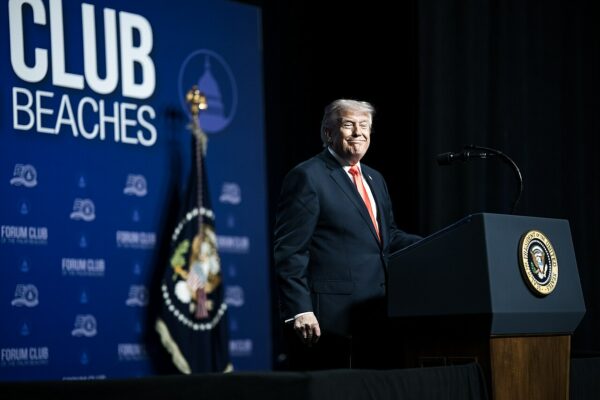
President Donald Trump is forcefully defending the framework agreement his administration signed with Iran this week, arguing that the deal advances U.S. objectives while opening the door to negotiations aimed at ending a months-long conflict that has reshaped the region.
The agreement, a 14-point memorandum of understanding (MOU), establishes a 60-day negotiation period focused on Iran’s nuclear program and the future of the Strait of Hormuz, one of the world’s most important shipping corridors. The waterway has remained closed during the conflict, disrupting trade and adding to international uncertainty.
In an interview with Axios on Thursday, Trump was pressed on whether the agreement fulfilled his earlier promise to achieve Iran’s “unconditional surrender.” While acknowledging the question, the president argued that the framework effectively accomplishes that objective.
“But really, probably is unconditional surrender,” Trump said of the MOU. “I think so.”
The president also used the interview to highlight what he described as the effectiveness of U.S. military operations during the conflict, particularly a naval blockade in the Strait of Hormuz. According to Trump, the blockade successfully cut off access to Iranian ports connected to the key oil-trading route.
“We have the most powerful military in the world by far,” Trump told Axios. “Who else could have done a blockade like that? I did a naval blockade where not one ship was able to get through. Some tried. Didn’t last very long.”
While supporters of the agreement view it as a potential path toward bringing the conflict to a close, the deal has generated skepticism from some Republicans who worry about its long-term implications.
Several GOP lawmakers have expressed concerns about provisions that would lift sanctions on Iran and establish a $300 billion reconstruction fund for the country. Critics argue that such measures could provide significant benefits to a government they continue to distrust.
Among the most outspoken critics has been Sen. Ted Cruz of Texas, who questioned the wisdom of providing large sums of money to Iran.
“History teaches that giving billions of dollars to theocratic lunatics who want to murder us is not a good idea. I think the president is receiving some very poor advice on this deal,” Cruz said Thursday.
Trump, however, has shown no sign of backing away from the agreement. Instead, he spent Friday morning defending both the deal and the administration’s conduct during the conflict in a series of posts on Truth Social.
In one post, the president argued that Iran has been significantly weakened by the war and rejected claims from political opponents that the country has emerged in a stronger position.
“The War has diminished Iran!” Trump wrote. He added that Iran no longer possesses an air force, navy, anti-aircraft equipment, radar systems, or much else, while criticizing Democrats who argue otherwise.
In a second post, Trump sought to reinforce his negotiating position by insisting that Iran entered talks from a position of weakness rather than strength.
“We didn’t meet out of desperation, Iran did,” he wrote.
The president also pushed back against concerns that Tehran would receive immediate financial benefits from the agreement, emphasizing that negotiations are only beginning and that the next 60 days will determine the shape of any final arrangement.
“They are FINISHED!” Trump declared. “We’ll play out the 60 days. They get no money, not ten cents!”
As negotiations move forward, the debate surrounding the agreement is likely to continue, with supporters viewing it as a possible route toward ending a costly conflict and critics questioning whether its concessions could outweigh its promises.
[READ MORE: White House Retires Long-Serving Air Force One as Qatari Jet Nears Presidential Service]