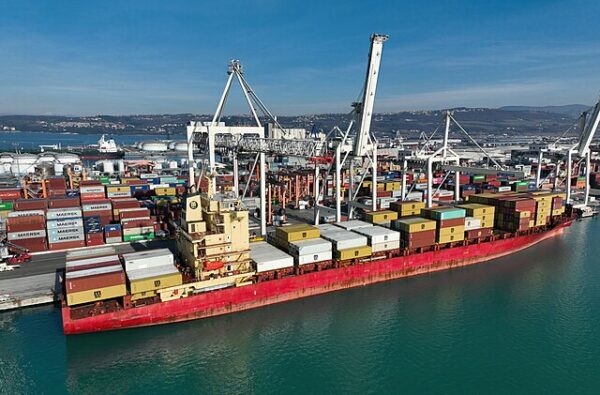
A cargo vessel operating near the Iran-Kuwait border suffered what officials described as a “large explosion” Monday, adding another layer of uncertainty to an already volatile region where military confrontations continue to disrupt commerce and international shipping.
According to the United Kingdom Maritime Trade Operations Center (UKMTO), the Panama-flagged container ship MSC Sariska V was struck by what was described as “an unknown projectile” approximately 40 nautical miles south of Umm Qasr, Iraq, near the Kuwaiti border.
The incident occurred amid escalating tensions between the United States and Iran and came shortly after reports of attacks involving Iranian forces and American military assets in the region.
Video circulated online, including footage shared by pro-Iran media outlets, appeared to show the MSC Sariska V sustaining significant damage. Images from the footage showed what looked to be a large hole in the side of the vessel as it took on water.
Despite the dramatic images, the vessel’s current condition remains unclear. Maritime tracking information indicated the ship, which had been traveling toward Qatar, was located at Umm Qasr following the incident.
The explosion was reported after a series of military exchanges between Washington and Tehran. According to the article, the United States intercepted an Iranian MQ-1 Reaper drone on Sunday that was targeting Kuwait, home to a major American military installation.
Kuwaiti military officials later reported that their forces were actively responding to what they described as hostile missile and drone attacks. Those statements were issued only hours before reports emerged that the MSC Sariska V had been struck.
The latest incident underscores how quickly commercial shipping can become entangled in broader geopolitical conflicts. While governments focus on military objectives and strategic calculations, cargo vessels and civilian maritime traffic often find themselves navigating increasingly dangerous waters.
Iran has repeatedly targeted Kuwait during both the war and subsequent cease-fire period, according to the report. American personnel were reportedly injured during one of the strikes carried out over the weekend.
The continuing conflict has also severely disrupted traffic through the Strait of Hormuz, one of the world’s most important maritime routes and a critical passageway for global energy shipments.
The strait has remained effectively shut down since March. Nevertheless, commercial traffic has not stopped entirely.
According to a report cited by The New York Times, U.S. Central Command stated that approximately 70 commercial vessels have successfully transited the Strait of Hormuz during the past three weeks despite the ongoing security risks.
The report said many of those ships attempted to avoid detection by switching off their transponders while navigating the area. They also reportedly received assistance from CENTCOM to help them avoid Iranian mines and drone threats.
Meanwhile, Iran’s Islamic Revolutionary Guard Corps offered a different account of maritime activity in the region.
The IRGC claimed that 15 vessels, including four oil tankers, passed through the strait during the previous 24 hours under Iranian supervision.
Even with those movements, maritime activity remains dramatically below normal levels.
Before the conflict erupted, more than 130 vessels crossed the Strait of Hormuz every day. Current traffic levels fall well short of those figures, highlighting the lingering impact the conflict continues to have on global shipping routes and regional trade.
As investigations continue into what struck the MSC Sariska V, the incident serves as another reminder of how fragile commercial transportation becomes when military confrontations spill into major shipping corridors. With competing claims, ongoing attacks and uncertainty surrounding the safety of regional waterways, commercial operators remain caught in the middle of a conflict that continues to reshape one of the world’s most strategically important maritime regions.
[READ MORE: Trump Taps Housing Regulator Bill Pulte as Acting National Intelligence Director]