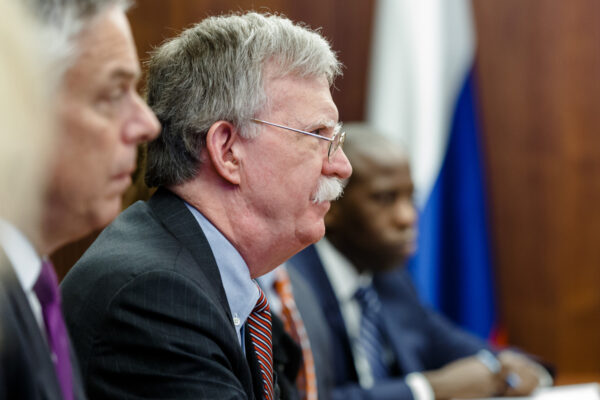
Former U.S. National Security Adviser John Bolton is now reportedly pressing President Donald Trump to escalate pressure on Iran, arguing that the administration has yet to “finish the job” in its ongoing confrontation with Tehran.
Speaking Sunday on NewsNation’s The Hill Sunday, Bolton laid out a more aggressive vision for U.S. policy, centered on both increasing military pressure and pursuing long-term regime change. He argued that while the United States currently holds a strategic advantage, it has not fully capitalized on that position.
“I think the United States holds a great advantage here, but it hasn’t finished the job that was started,” Bolton said. He defined that goal in stark terms, calling for the ousting of Iran’s leadership, though he also outlined steps short of that outcome that he believes could intensify pressure without immediately returning to broader hostilities.
Among those steps, Bolton suggested the use of military force to reopen the Strait of Hormuz, a key global shipping route that has become a flashpoint in recent tensions. He framed the idea as a targeted move that would avoid repeating the scale of attacks seen in recent weeks, while still exerting economic pressure on Iran by maintaining a blockade on its oil shipments.
Bolton argued that such an approach could achieve multiple objectives at once: increasing financial strain on Tehran, restoring the flow of oil into international markets, and maintaining momentum without forcing the administration into what he described as more difficult decisions.
His comments reflect a longstanding position. Bolton has consistently advocated for a harder line on Iran, often emphasizing the need for decisive action rather than prolonged standoffs. Earlier this year, during an appearance on NewsNation’s Cuomo, he criticized what he described as “self-inflicted mistakes” in the administration’s approach, even as he expressed support for the broader objective of confronting Iran’s leadership.
At the same time, his latest remarks arrive amid growing concerns about the risks of further escalation. While Bolton dismissed reports that the U.S. missile stockpile could be significantly depleted, he acknowledged that it is a serious issue in the long term. Still, he insisted that such concerns should not influence immediate decision-making in the conflict.
“I don’t think this issue, which is a serious issue in the long term, will or should affect Trump’s decision-making in the here and now,” he said.
The exchange highlights an ongoing debate within policy circles over how far the United States should go in its efforts to pressure Iran. On one side are voices like Bolton’s, calling for increased force and a clearer endgame. On the other are those wary of actions that could draw the U.S. deeper into a prolonged conflict with unpredictable consequences.
Even Bolton’s proposed middle-ground steps carry inherent risks. Moves to open the Strait of Hormuz by force, while potentially limited in scope, could still provoke retaliation and further destabilize an already tense region. History has shown that conflicts involving vital economic corridors can escalate quickly, often in ways that are difficult to control once underway.
For the Trump administration, the challenge remains balancing pressure with restraint — a delicate calculation that weighs immediate strategic gains against the possibility of a broader and more costly confrontation.
As calls for stronger action grow louder, the question facing U.S. leadership is not only how to respond, but how to avoid a path that could ultimately lead back to a larger war — one that many argue would carry consequences far beyond the region itself.
[READ MORE: Trump Announces New Phase In Iran]