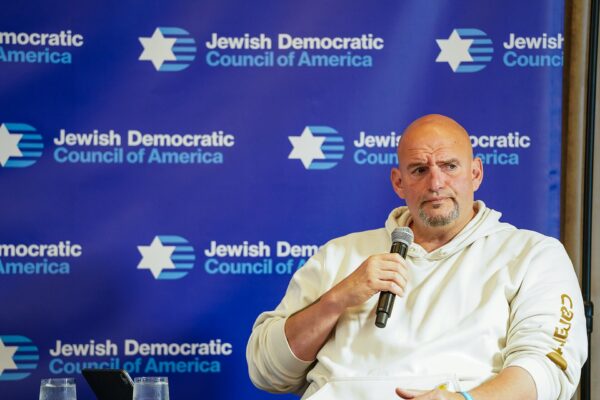
President Donald Trump and Republican leaders are reportedly quietly exploring an unconventional strategy to maintain their grip on the Senate: persuading John Fetterman to cross party lines.
According to reporting from Politico’s Jonathan Martin, some Republicans believe that even if they lose as many as four seats in the upcoming election, flipping Fetterman could help them retain control of the chamber. The effort reflects both the razor-thin margins in Washington and a growing sense that traditional party loyalties may not be as fixed as they once were.
Trump himself has reportedly made a direct pitch, offering what Martin described as his “total and complete endorsement” along with potential financial backing. At the same time, several Senate Republicans have been engaging Fetterman more quietly, gauging his openness to a shift or even an independent status.
Fetterman, however, has publicly pushed back on the idea. “I’m not changing,” he told Martin. “I’m a Democrat and I’m staying one.” The Pennsylvania senator reiterated that stance in a recent interview, emphasizing that his voting record remains aligned with his party, even as he acknowledges disagreements.
Still, behind the scenes, the picture appears more nuanced. When one Republican floated the possibility of Fetterman becoming an independent, the senator did not immediately reject the suggestion, according to a GOP official familiar with the conversation. That ambiguity has kept speculation alive, even as Fetterman insists he is not switching parties.
Part of what’s fueling Republican optimism is Fetterman’s increasingly visible comfort among GOP colleagues. Martin described the Senate environment as resembling a “high school cafeteria,” noting that Fetterman now spends significant time with Republicans rather than attending Democratic gatherings. He reportedly skips regular Democratic caucus lunches and has formed a working relationship with Senate Majority Leader John Thune, with whom he exchanges text messages.
His physical presence in Republican spaces has also drawn attention. After initially avoiding both parties’ gathering spots, Fetterman has begun spending extended periods in the GOP cloakroom during votes, often socializing with Republican senators and their staff. Over time, those interactions have evolved into deeper personal connections.
Martin’s reporting highlights particularly strong ties between Fetterman and Senator Dave McCormick and his wife, as well as Senator Katie Britt and her husband. These relationships, according to unnamed officials, could play a key role if Fetterman were ever to reconsider his political alignment.
At the same time, Fetterman has not shied away from criticizing elements of his own party. In his Fox News interview, he pointed to disagreements on border policy, arguing that the Democratic Party has taken a stance he does not support. He expressed backing for stronger border security measures and the deportation of criminals, positions that have put him at odds with some fellow Democrats.
Yet he also made clear that those differences do not translate into full agreement with Republicans. “I can’t be a Republican because in many other areas, I disagree,” Fetterman said, adding that even if he feels “politically homeless,” he intends to remain a Democrat.
His relationship with Democratic colleagues appears strained, though he downplayed any outright conflict. When asked about it, he laughed before describing the dynamic as “cordial,” while acknowledging he is “not necessarily the popular guy.”
The situation underscores a broader reality in today’s political climate: alliances can shift, and internal divisions can be just as consequential as partisan battles. For Republicans, the outreach to Fetterman represents a strategic gamble aimed at securing power in a closely divided Senate. For Fetterman, it highlights the challenge of navigating personal convictions within a polarized system.
Whether the effort gains traction or ultimately fades, it reflects a political moment where control of Congress may hinge not only on elections, but on the decisions of a few key figures willing — or unwilling — to cross the aisle.
[READ MORE: Trump Announces New Phase In Iran]