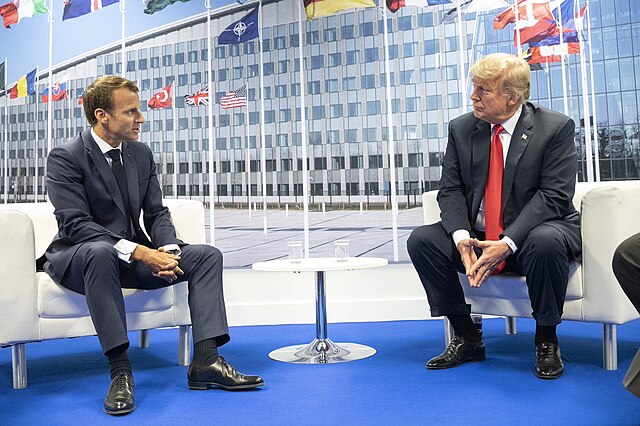
French President Emmanuel Macron pushed back Thursday after President Donald Trump took a personal swipe at his marriage during a private White House event, an exchange that quickly added another layer of friction to already strained relations over the ongoing conflict with Iran.
The remarks from Trump surfaced in a video briefly posted to the White House’s YouTube page before being taken down. Speaking at a closed-door lunch with guests, the president criticized NATO allies for declining to join the U.S.-Israeli military operation in Iran, suggesting their absence was ultimately inconsequential.
“We didn’t need them, but I asked anyway,” Trump said, before turning to Macron with a comment that drew immediate attention. “I call up France, Macron – whose wife treats him extremely badly. Still recovering from the right to the jaw.”
The remark appeared to reference a widely circulated video from May 2025 that showed Brigitte Macron pushing the French president’s face during a trip to Vietnam—an incident Macron later dismissed as the couple “joking as we often do.”
On Thursday, Macron responded with restraint but made clear his disapproval. Calling Trump’s comments “neither elegant nor of a high standard,” he declined to engage further on the personal attack, saying it did not warrant a detailed response.
Instead, the French leader pivoted to what he framed as the more pressing issue: the war itself. Macron criticized the focus on personal insults at a time when lives are at stake, emphasizing the human and economic toll of the conflict.
“We’re talking about too serious things,” Macron said. “We’re speaking of war… women and men and civilians who are killed… and the consequences of this war on our economies.” He pointed to rising energy costs affecting citizens on both sides of the Atlantic, noting that Americans are experiencing similar pressure from higher gas prices.
The episode also sparked backlash within France, where opposition lawmakers condemned Trump’s remarks as “unacceptable” and beneath the dignity of the presidency. Their reaction underscores how personal rhetoric, even in private settings, can quickly spill into the public arena and complicate already delicate diplomatic relationships.
The dispute comes at a time of growing disagreement between Washington and key European allies over how to handle Iran. France, along with other NATO partners, has declined to participate in military strikes, a decision that has drawn frustration from Trump. The president has repeatedly called on allies to take a more active role, particularly in efforts to reopen the Strait of Hormuz, a vital global trade route that has been effectively shut down amid the conflict.
The closure of the strait has sent shockwaves through international markets, contributing to rising oil prices and broader economic uncertainty. Trump has argued that nations heavily dependent on Middle Eastern energy should step in, while European leaders have taken a more cautious approach.
Adding to the tension, Trump told The Telegraph on Thursday that he could consider leaving NATO, a statement likely to raise further concerns among allies already wary of the administration’s direction.
While the exchange between Trump and Macron may appear personal on the surface, it reflects deeper divisions over strategy, burden-sharing, and the costs of an expanding conflict. As leaders navigate both military and economic fallout, moments like this highlight how quickly diplomacy can be overshadowed—at a time when the stakes, both human and financial, continue to rise.