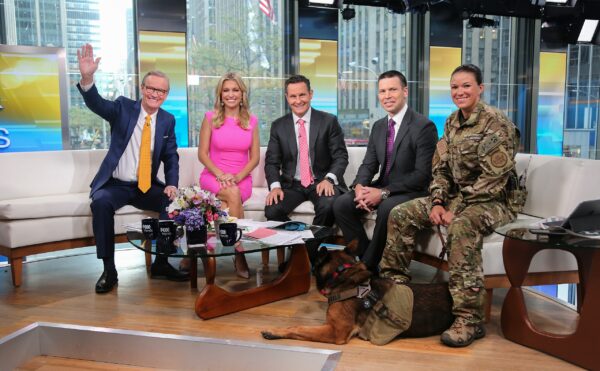
Hosts on Fox News this week revealed the extraordinary security precautions reportedly taken by the U.S. delegation and traveling press corps during President Donald Trump’s recent trip to China, underscoring the deep distrust that continues to define relations between Washington and Beijing even amid public diplomatic outreach.
During a segment on Fox & Friends, co-host Brian Kilmeade raised concerns about future agreements involving Chinese technology, suggesting the trip highlighted the risks American officials still associate with Beijing despite the highly publicized summit between Trump and Chinese President Xi Jinping.
Kilmeade described the issue as a major “worry,” particularly given longstanding concerns in Washington about espionage and surveillance tied to Chinese technology infrastructure.
Co-host Lawrence Jones then pointed to reporting from Emily Goodin, who described how American staff members reportedly disposed of their “burner phones” before boarding Air Force One for the flight home.
“Nothing from China allowed on the plane,” Jones said while discussing the precautions.
He argued the actions reflected a broader reality beneath the carefully staged diplomacy surrounding the trip.
“Americans are saying we understand the threat of China,” Jones explained. “We’re going try to play nice, try to get something done publicly, but privately we’re doing to deal with what is true.”
According to press pool reports referenced during the discussion, White House staff also asked journalists traveling with the president to surrender badges and lapel pins issued for the visit after Chinese officials reportedly requested their return. The materials were allegedly collected in bins alongside burner phones used during the trip.
Co-host Ainsley Earhardt expanded on the security measures, saying she had spoken with sources familiar with the arrangements aboard the presidential trip.
According to Earhardt, American officials and journalists were instructed either to leave their personal phones behind in the United States or keep them powered off while in China.
“They had to leave their American phones, turn them off,” Earhardt said. “They did not take them into China, or if they did they left them on the planes.”
She added that all Americans involved in the trip relied on temporary burner phones that were later destroyed and discarded before departing the country.
“They don’t want anything that belongs to the Chinese on that plane because they could be bugged,” Earhardt said. “There could be spies.”
Earhardt also described tight hotel security protocols and reported that security sweeps were conducted before American officials entered rooms used during the visit, particularly those involving the president.
“The security was so tight apparently at the hotels and rooms,” she said, noting that officials conducted extensive sweeps “especially the president’s room.”
The revelations offered a rare glimpse into the level of caution surrounding high-level diplomatic travel between the world’s two largest powers. Publicly, the Beijing summit was celebrated as a successful effort to improve communication and manage tensions between Washington and Beijing. Privately, however, the extraordinary precautions described by the traveling delegation suggested that deep mistrust still dominates the relationship.
The episode also reflected the increasingly fragile state of modern diplomacy in an era where technology itself has become part of geopolitical conflict. Even as leaders pursue trade negotiations, military discussions, and cooperation on issues like artificial intelligence, both nations continue operating under the assumption that espionage, cyber monitoring, and surveillance remain constant realities.
For many Americans, the contrast between the summit’s pageantry and the behind-the-scenes security measures served as a reminder that the growing rivalry between the United States and China is no longer confined to economics or military power alone, but now extends into nearly every aspect of communication, technology, and global influence.