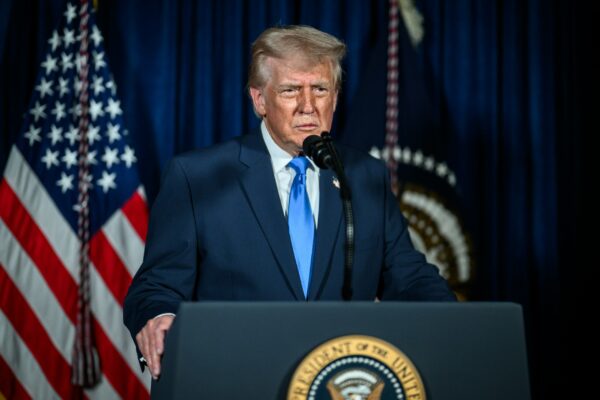
President Donald Trump stirred frustration among parts of his MAGA base this week after defending the presence of hundreds of thousands of Chinese students in American universities and arguing that removing Chinese buyers from the U.S. farmland market could hurt American farmers.
During an interview with Sean Hannity on Fox News, Trump acknowledged concerns about Chinese ownership of land near sensitive sites but argued the issue is more economically complicated than many conservatives would like to admit.
Hannity pressed the president by noting that China would never allow Americans to purchase property near Chinese military installations.
“I would assume I’m in Beijing if I wanted to buy property near one of their military installations,” Hannity said.
Trump responded that while he does not necessarily “love” the situation, abruptly cutting Chinese buyers out of the market could drive down farmland values and financially hurt American farmers.
“They’ve had a lot of land for a long time,” Trump said, while also blaming former President Barack Obama for failing to stop purchases during his administration.
The president’s remarks quickly drew criticism from some conservatives who have increasingly viewed Chinese ownership of American farmland as both an economic and national security threat.
Trump also defended allowing roughly 500,000 Chinese students to study in the United States, describing many of them as “good students” and arguing that banning them outright would damage America’s university system.
According to Trump, lower-tier colleges and universities rely heavily on international students and could collapse financially without them.
“If you want to see a university system die, take a half a million people out of it,” Trump said, arguing that elite schools would survive but smaller institutions would struggle badly.
The president also suggested it would be insulting to tell China that its students are not welcome in American schools.
“It’s a very insulting thing to tell a country, ‘We don’t want your people in our schools,’” Trump said.
Trump argued that many foreign students come to America, learn American culture, and in some cases choose to remain in the United States, which he framed as beneficial overall.
At the same time, he acknowledged the national security concerns surrounding Chinese students and espionage fears.
“Sure, I know, and we worry about that,” Trump told Hannity. “They do things to us, and we do things to them. It’s a very fine line.”
The president described his position as rooted more in “common sense” than ideology, insisting that the MAGA movement ultimately stands for strong borders, a strong military, good education, and economic stability.
Still, the comments sparked sharp reactions from some longtime MAGA figures who viewed Trump’s remarks as too accommodating toward Beijing.
Mike Cernovich shared the interview clip on X and asked, “Has China defeated our country?”
Meanwhile, Idaho state Rep. Heather Scott responded by emphasizing that Idaho has already passed laws preventing Chinese ownership of farmland within the state.
“China won’t be purchasing farmland in Idaho,” Scott wrote.
The disagreement highlights a growing divide inside conservative circles over how aggressively the United States should confront China economically and culturally. While many Republicans increasingly favor strict limits on Chinese investment and tighter restrictions on foreign students, others worry that severing educational and economic ties too abruptly could damage American institutions, businesses, and agriculture.
Trump’s comments also underscored the delicate balancing act facing his administration as tensions between Washington and Beijing continue to rise. Even as political rhetoric between the two powers grows sharper, both countries remain deeply intertwined through trade, technology, education, and financial systems — connections that many leaders appear reluctant to fully unwind despite mounting geopolitical distrust.
For many conservatives, the debate now centers on where that line between competition and overdependence should ultimately be drawn.
[READ MORE: China Says Iran Conflict “Should Not Have Happened” as Trump Pushes for Strait of Hormuz Stability]