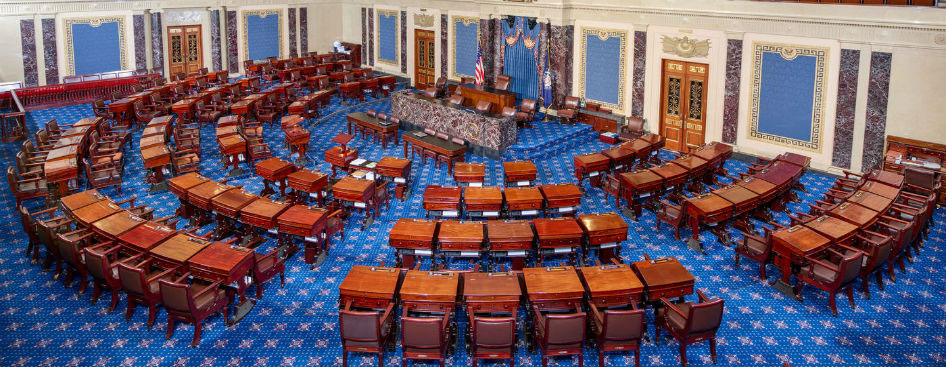
The Senate moved swiftly in the early hours of Friday morning to end a prolonged shutdown of the Department of Homeland Security, unanimously approving a funding package after 40 days of disruption — but not without setting up a looming fight over immigration policy in the House.
The measure passed by voice vote at approximately 2:20 a.m. following a marathon round of negotiations, reflecting both the urgency of reopening critical government functions and the deep divisions that remain unresolved. While lawmakers reached agreement on funding most DHS operations, the deal notably excludes money for Immigration and Customs Enforcement and Customs and Border Protection, two agencies at the center of ongoing political battles.
The breakthrough came as the effects of the shutdown became increasingly difficult to ignore. Airport delays stretched as long as four hours, fueled in part by unpaid Transportation Security Administration officers who had missed multiple paychecks. In response, President Donald Trump announced he would order immediate pay for TSA workers, a move that appeared to add momentum toward a resolution.
Despite the agreement, the path forward remains anything but settled. By stripping out funding for ICE and CBP, lawmakers effectively postponed the most contentious issue, kicking it into a separate debate that is already shaping up to be a high-stakes political confrontation.
Senate Minority Leader Chuck Schumer made clear that Democrats view the outcome as a strategic win, signaling their intent to continue pushing for changes to enforcement policies. He said Democrats would work to ensure those programs “do not get more funding without serious reform,” calling the agreement “exactly what we wanted.”
Republicans, along with the White House, had resisted efforts to tie broader DHS funding to restrictions on immigration enforcement. Instead, the compromise isolates ICE funding into a standalone vote — one that Democrats have already blocked, underscoring the difficulty of reaching consensus on the issue.
Now, attention shifts to the House, where Speaker Mike Johnson faces a delicate balancing act. With Republicans in control, Johnson could move quickly to advance the Senate package. However, he is also likely to encounter resistance from conservatives who oppose separating immigration enforcement funding from the larger DHS budget, arguing that border security should not be treated as an afterthought.
The standoff highlights a broader tension in Washington: the challenge of maintaining essential government operations while navigating sharply divided views on national priorities. While the Senate’s action brings temporary relief and restores key services, it does little to resolve the underlying disputes that led to the shutdown in the first place.
As lawmakers turn to the next phase of negotiations, the debate over immigration enforcement — and how it should be funded — is poised to take center stage once again. And as with many policy battles tied to national security, the consequences of prolonged gridlock can ripple beyond Washington, affecting not just government workers, but everyday Americans who rely on stable systems at home.
For now, the government is back open, but the deeper fight over direction, priorities, and the costs — both financial and otherwise — is far from over.
[READ MORE: Trump To Sign 100 Bill For 250th]