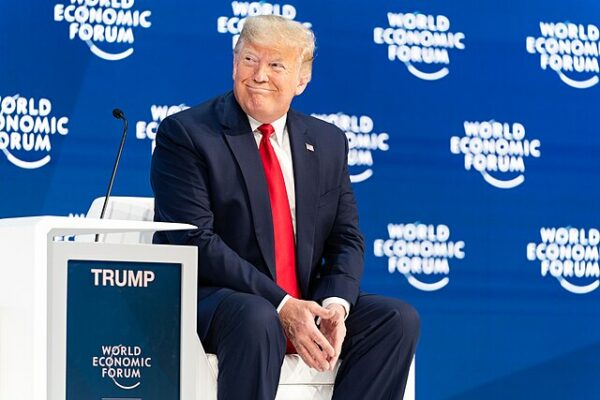
President Donald Trump on Sunday reportedly shut down a bipartisan proposal aimed at ending the 37-day government shutdown, choosing instead to hold firm on key immigration and election priorities — a move that has left Washington at a standstill with no clear path forward.
The proposal, quietly advanced by Senate Majority Leader John Thune, R-S.D., had gained traction among both Republicans and Democrats. According to senators and aides cited by Punchbowl News, the plan would have funded the Department of Homeland Security, ensuring that essential operations like airport security continued uninterrupted, while temporarily setting aside the most contentious issue: funding for Immigration and Customs Enforcement.
Under the framework, Transportation Security Administration agents would have been paid and airport operations stabilized, offering some immediate relief to travelers and federal workers alike. The thornier dispute over ICE funding would have been postponed and addressed later through a party-line reconciliation bill.
The compromise also stopped short of meeting several Democratic demands, including proposals related to federal agent conduct such as a mask ban and requirements for judicial warrants. Still, Thune reportedly told the president that Democrats were prepared to accept the deal — a rare moment of potential agreement in an otherwise deeply divided Senate.
But Trump rejected the proposal outright.
According to reports, the president instead urged Republicans to remain in Washington and continue pressing Democrats to agree not only to full DHS funding, including ICE, but also to the SAVE America Act, a sweeping GOP-backed bill focused on voter identification and election procedures.
Hours after the reported meeting, Trump made his position unmistakably clear in a lengthy Truth Social post, blasting Democrats and warning Republicans who might support compromise.
“I don’t think we should make any deal” with Democrats, Trump wrote, unless they agree to pass the SAVE America Act. He described the legislation as more important than any other item before the Senate, including the funding measures at the center of the shutdown fight.
The president also took aim at the proposed reduction in ICE funding, calling it unacceptable and tying it to broader demands on election rules and related policies. In a sharp warning to dissent within his own party, Trump called on Thune to identify Republicans he believes are not supporting the agenda, suggesting they would face political consequences.
The episode highlights the increasingly high stakes of the shutdown battle, where even proposals with bipartisan backing are struggling to gain traction amid competing priorities and political pressure. For many lawmakers, the Thune proposal represented a pragmatic step toward reopening parts of the government while deferring more divisive issues.
Yet Trump’s decision to reject the deal underscores a broader strategy: linking must-pass funding legislation with long-standing policy goals, even if it risks prolonging the standoff.
The result is a familiar kind of gridlock, where negotiations stall and the practical impacts of the shutdown continue to ripple outward. While the debate centers on immigration enforcement and election law, the immediate consequences are felt in areas like airport security and federal operations — reminders that even political battles far from the front lines can carry real-world costs.
With neither side appearing ready to back down, the shutdown shows no immediate signs of ending, leaving lawmakers under pressure to find a path forward — or face the consequences of a prolonged impasse.
[READ MORE: Trump To Deploy ICE To Airports To Help TSA]