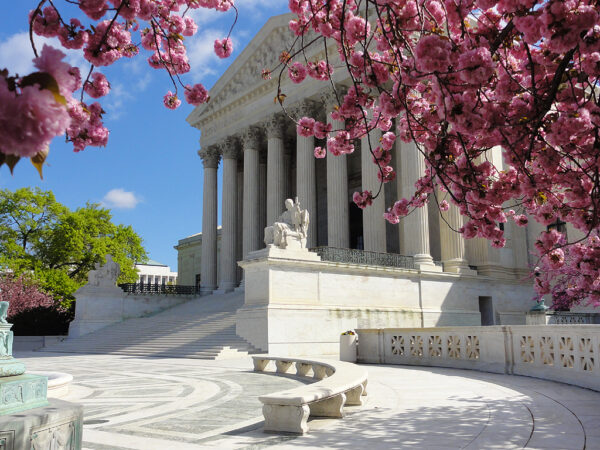
President Donald Trump announced Friday that he will “immediately” appeal to the U.S. Supreme Court after a federal appeals court blocked construction of his planned White House ballroom, ruling the project could not proceed without congressional approval.
In a 2-1 decision, the U.S. Court of Appeals for the District of Columbia determined that construction should be halted, citing Congress’s constitutional authority over the White House and its surrounding property.
“The White House is the People’s House, and under the Constitution’s Property Clause, Congress exercises plenary control over the building and its surrounding land,” the court wrote in its ruling.
Trump responded in a lengthy Truth Social post, sharply criticizing the decision and accusing “two Obama and Biden Appellate Court Judges” of blocking what he described as a critical project. Throughout his statement, the president referred to the planned ballroom as a “desperately needed Military Center” and argued that the court’s decision jeopardized national security.
The president also highlighted the dissenting opinion written by Judge Neomi Rao, whom he appointed to the appeals court. Trump quoted Rao’s criticism of the majority’s decision, noting that she described it as “a blatant abuse of discretion” and argued that “construction should be allowed to continue.”
Trump maintained that the project extends far beyond a traditional ballroom, describing it as part of a broader, integrated complex designed to enhance security at the White House.
According to the president, military officials and members of the U.S. Secret Service view the ruling as a threat to national security because the construction project is intended to strengthen protections for the White House and future presidents.
“The Military and Secret Service are viewing this horrendous, politically motivated, and unlawful ruling as a National Security threat to our Nation in that the entire Complex is being built for the protection of our Country and, additionally, all future Presidents,” Trump wrote.
The president said the project includes a wide range of security and defense-related infrastructure. He listed bomb shelters, state-of-the-art hospital and medical facilities, protective partitioning, top-secret military facilities, protective missile-resistant steel, reinforced columns, roofs and beams, drone-resistant ceilings and roofs, military-grade ventilation systems, and bullet-, ballistic-, and blast-resistant glass as components of the overall project.
Trump argued that the various elements were designed as one integrated system and should not be viewed as separate construction efforts.
“It is all tied together as one big, expensive, and very complex unit, which is vital for National Security and Military Operations of the United States of America,” he wrote.
The president also challenged the court’s ruling on legal standing, arguing that the plaintiffs should not have been permitted to bring the case. He contended that the decision places at risk the safety of White House employees, future presidents and their families, visiting heads of state, foreign dignitaries, and members of the public who visit the Executive Mansion.
Trump further noted that much of the project has already been completed or is well underway.
“The entire Complex, Military and all, is largely built, fabricated, and paid for. Much is already on site, or being delivered,” he wrote.
He also questioned the timing of the legal challenge, asking why the lawsuit had not been filed before construction began.
The lawsuit seeking to stop the project was filed in December, following the demolition of the White House East Wing in October 2025. According to the article, the demolition occurred before the Commission of Fine Arts and the National Capital Planning Commission approved the ballroom’s design, which did not occur until early 2026.
Trump said he plans to take the dispute directly to the Supreme Court in an effort to overturn the appeals court’s ruling and allow construction to continue.
[READ MORE: Trump Narrows $10 Billion Defamation Lawsuit Against BBC, Drops Business Damage Claims]