President Donald Trump escalated his public feud with former ally Tucker Carlson this week, responding sharply to the commentator’s warning that the administration’s posture toward Iran could edge the nation toward a catastrophic conflict.
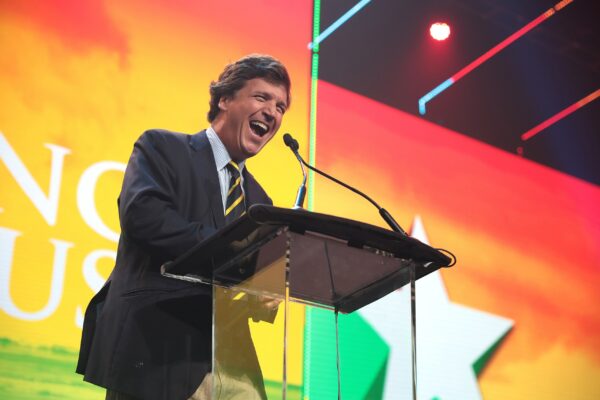
The clash highlights a growing divide within conservative circles, where support for a strong national defense is increasingly weighed against concerns about the risks of deeper military entanglement. Carlson, speaking on Monday’s episode of The Tucker Carlson Show, took direct aim at the president’s recent rhetoric, particularly an Easter Sunday statement in which Trump threatened Iran’s civilian infrastructure.
Carlson framed the moment in stark terms, suggesting the language marked a dangerous turning point. He urged those close to the president to intervene, arguing that the stakes could not be higher. In unusually urgent remarks, he called on officials with direct access to Trump to consider refusing orders they viewed as reckless, even suggesting resignation if necessary.
“This is not hysteria,” Carlson said, warning that the situation was “100% real” and that the consequences could spiral into a broader, potentially nuclear conflict. His comments reflect a strain of skepticism among some on the right who, while supportive of American strength abroad, remain wary of escalation that could draw the U.S. into another far-reaching war.
Trump, however, dismissed Carlson’s concerns outright. In an interview with the New York Post, the president lashed out at his former ally in blunt terms, questioning both his intelligence and credibility. Trump claimed Carlson frequently attempts to contact him, adding that he no longer engages.
The president’s remarks are the latest in a series of public criticisms aimed at Carlson. Just last week, Trump amplified a New York Post article that labeled the commentator a “deranged” back-stabber and accused him of promoting controversial voices. The rhetoric underscores how sharply relations between the two have deteriorated.
The tension has been building for months. In a March interview with ABC News, Trump argued that Carlson had “lost his way,” distancing him from the broader MAGA movement. He emphasized that his political vision centers on an “America first” agenda, suggesting Carlson no longer aligns with those priorities.
For his part, Carlson has struck a more conciliatory tone in response to the personal attacks. Despite the escalating rhetoric, he said he would continue to support Trump on a personal level, signaling that the disagreement may be rooted more in policy and direction than in outright political opposition.
Still, the substance of the dispute points to a deeper question facing the conservative movement: how to balance assertive foreign policy with caution about unintended consequences. Carlson’s warnings, while controversial, echo a long-standing concern that heated rhetoric can quickly narrow the path away from conflict.
Trump, meanwhile, has remained steadfast in defending his approach, portraying critics as out of touch with the realities of global threats. The back-and-forth underscores a broader debate—one that is unlikely to fade—as tensions abroad continue to test the limits of both rhetoric and restraint.
As the disagreement plays out in public, it serves as a reminder that even among allies, the line between strength and escalation can be a matter of fierce contention.
[READ MORE: Trump Warns Iran Will ‘Die’ Tonight]