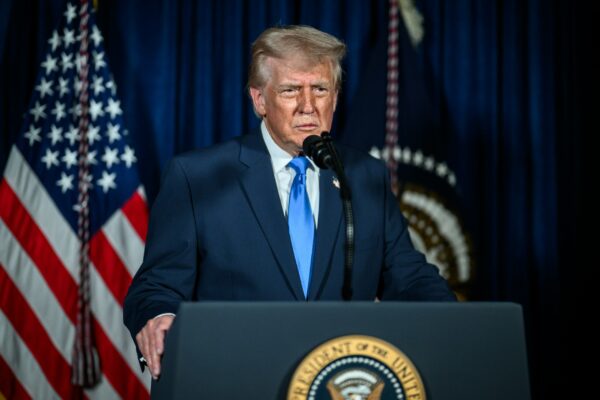
President Donald Trump offered a striking defense of allowing Iran to retain some conventional missile capabilities during remarks at the conclusion of the Group of Seven summit in Evian-les-Bains, France, arguing that ballistic missiles are not the central threat facing the international community.
Speaking Wednesday afternoon during a lengthy press conference, Trump spent much of his time discussing the recently leaked Iran Memorandum of Understanding, a proposed 14-point framework that reportedly includes the creation of a $300 billion reconstruction fund. While the agreement has sparked intense debate, Trump sought to explain his administration’s approach to balancing regional security concerns with the broader goal of preventing nuclear escalation.
The president indicated that discussions with Gulf nations would continue on issues beyond Iran’s nuclear program, including Tehran’s conventional ballistic missile arsenal and its support for terrorist proxy groups. But when the subject turned to whether Iran should be permitted to possess any missiles at all, Trump pushed back against what he portrayed as an unrealistic position.
According to the president, some advisers and commentators have argued that Iran should be barred from maintaining any missile capability whatsoever. Trump responded by questioning whether such a standard could be applied fairly across the region.
“We’ll be working on a parallel effort with the Gulf nations to address non-nuclear issues such as the conventional ballistic missiles,” Trump said. “I mean, they have to have some because other people have some, and they’ve got to have some.”
The president then launched into a humorous reenactment of conversations he said he has had with individuals urging a complete prohibition on Iranian missiles. Mimicking the exchange, Trump described critics telling him that Iran should not be allowed to possess “any missile.”
Trump argued that such a position ignores the realities of regional military balances.
“What am I going to do?” he asked. “Am I going let Saudi Arabia have missiles but they can’t have them?”
The president maintained that missiles, while dangerous, are fundamentally different from nuclear weapons and should not be viewed as the primary threat in negotiations.
“It doesn’t work that way,” Trump said. “And missiles aren’t the problem.”
He then delivered the line that quickly became one of the most talked-about moments of the press conference.
“Missiles are — they hurt a little location, but they don’t blow up the planet,” Trump remarked.
The comment underscored the administration’s apparent focus on preventing nuclear proliferation rather than eliminating every conventional military capability possessed by adversarial nations. While missiles can still inflict destruction and loss of life, Trump emphasized that nuclear weapons remain in a category of their own due to their potentially catastrophic consequences.
Beyond missile issues, Trump said future discussions would also focus on Iran’s support for terrorist proxy organizations, a concern long shared by many countries in the region.
The president concluded the portion of his remarks by praising international partners who he said played important roles in ongoing diplomatic efforts. Trump specifically thanked Pakistan and Qatar, saying representatives from both countries had worked hard throughout the process.
“I want to thank our partners in both Pakistan and Qatar,” Trump said. “These people work so hard.”
As debate continues over the proposed agreement, Trump’s remarks highlighted the administration’s effort to distinguish between containing nuclear threats and managing broader regional security challenges without expanding conflict further.
[READ MORE: Trump Warns Iran Deal Is Not Final, Says Military Pressure Remains an Option if Agreement Falls Short]