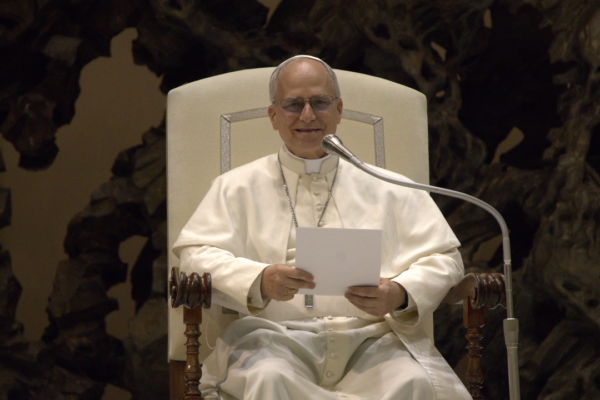
President Donald Trump escalated his ongoing dispute with Pope Leo XIV on Monday, accusing the pontiff of undermining safety for Catholics through his criticism of the war involving Iran.
Speaking during a phone interview with conservative radio host Hugh Hewitt, Trump argued that the Pope’s focus on opposing the conflict—and his broader commentary—risked emboldening adversaries at a time of heightened tensions. The president claimed the pontiff’s stance effectively signaled acceptance of Iran possessing nuclear weapons, a position Trump said could have dangerous consequences.
The exchange arose as Hewitt pressed Trump on a separate international issue: the case of Hong Kong publisher Jimmy Lai. Lai, a vocal advocate for free speech, was arrested in 2020 and charged with offenses including publishing what authorities described as “seditious material,” a case widely criticized as politically motivated.
Trump said he plans to raise Lai’s situation again with Chinese President Xi Jinping during an upcoming meeting. He noted that he had previously asked Xi to “consider” Lai’s release in December. Hewitt urged both Trump and the Pope to speak out more forcefully on Lai’s behalf, suggesting it would be a meaningful step toward defending free expression.
While Trump agreed he would bring up Lai, he used the moment to pivot back to his disagreement with Pope Leo, suggesting the pontiff had chosen to focus instead on condemning the war with Iran. Trump characterized the Pope’s position as overly permissive toward Iran’s nuclear ambitions, saying it could place “a lot of Catholics and a lot of people” at risk.
The criticism marks the latest in a series of sharp remarks Trump has directed at the Pope in recent weeks. The dispute began after Pope Leo publicly condemned Trump’s earlier threat to destroy what he described as an entire civilization in Iran if a deal was not reached. The pontiff later reiterated his opposition to the conflict more broadly, declaring that “God does not bless any conflict.”
Trump has continued to respond forcefully, at one point accusing the Pope of being “weak on crime,” further intensifying the unusual back-and-forth between a U.S. president and a religious leader.
The disagreement highlights a deeper divide over how to approach international conflict. While Trump has emphasized strength and deterrence, the Pope has framed the issue in moral terms, warning against the human cost of war and urging restraint. The tension between those perspectives has become increasingly visible as the conflict with Iran unfolds.
Amid the dispute, Secretary of State Marco Rubio was asked whether his upcoming trip to Italy—where he is expected to meet with the Pope—was intended to ease tensions. Rubio downplayed the idea, saying the visit was routine and consistent with past diplomatic engagements by U.S. officials.
“The trip is really not tied to anything other than the fact that it would be normal for us to engage,” Rubio said, noting that similar visits have been made by previous secretaries of state.
Even so, the timing of the meeting underscores the delicate balance facing U.S. leaders as they navigate both geopolitical conflict and public criticism from influential voices abroad. As the rhetoric intensifies, the broader question remains whether such disputes will complicate efforts to resolve the conflict—or serve as a reminder of the high stakes involved when war and diplomacy collide.
[READ MORE: Trump Strikes Back Against Republicans Who Refused To Gerrymander]