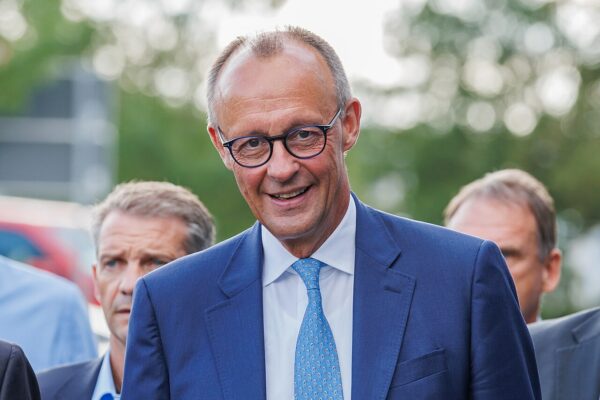
President Donald Trump sharply criticized German Chancellor Friedrich Merz on Tuesday, escalating a war of words tied to the ongoing conflict with Iran and the broader debate over how the United States is handling negotiations.
The dispute began after Merz suggested that Iran had managed to “humiliate” the United States during the course of the war, a claim that drew a swift and forceful response from Trump. Posting on Truth Social, the president dismissed the German leader’s remarks and argued that Merz fundamentally misunderstands the stakes involved.
Trump accused Merz of being out of touch, claiming the German chancellor was effectively comfortable with the idea of Iran obtaining a nuclear weapon. The president warned that such a development would have sweeping consequences, arguing that a nuclear-armed Iran would place the entire world in a precarious position. He maintained that his administration is taking action now that should have been taken by other leaders long ago, while also taking a swipe at Germany’s economic and broader performance.
Merz’s original comments came a day earlier during remarks to students in the German town of Marsberg, where he criticized the handling of negotiations with Iran. He suggested that Iranian leadership had outmaneuvered the United States diplomatically, pointing to a failed effort in which American officials traveled to Islamabad only to leave without results.
According to Merz, Iran’s approach to negotiations has been less about reaching agreement and more about avoiding commitments altogether. He described the situation as one in which an entire nation — the United States — was being embarrassed by Iran’s leadership, particularly its Revolutionary Guards, and expressed hope that the conflict would come to an end quickly.
The backdrop to the exchange is a war that began on February 28, when joint U.S. and Israeli strikes killed Iranian Supreme Leader Ali Khamenei. While a fragile ceasefire is now in place, uncertainty remains about how long it will hold, especially as negotiations continue to stall.
Efforts to bring the conflict to a close have already faced setbacks. Last week, Trump canceled plans to send Vice President JD Vance, special envoy Steve Witkoff, and adviser Jared Kushner back to Pakistan for another round of talks. An earlier round of negotiations in early April had collapsed, with Vance stating that Iran failed to make a clear commitment to forgo pursuing a nuclear weapon.
For Trump, that issue remains non-negotiable. Speaking to reporters on April 25, he reiterated that preventing Iran from obtaining a nuclear weapon is the central objective, describing the matter as straightforward despite the complexities surrounding the conflict.
In a twist that underscores the unpredictable nature of the situation, Trump also said Iran delivered what he described as a “much better” proposal to end the war just minutes after he canceled the planned follow-up summit.
The exchange between Trump and Merz highlights not only the strain between allies but also the broader uncertainty surrounding the conflict itself. While leaders trade sharp words over strategy and outcomes, the underlying reality remains a fragile ceasefire and unresolved tensions — a reminder that even as negotiations continue, the costs and consequences of prolonged conflict linger in the background.
[READ MORE: Megyn Kelly Blasts Media “Overreaction” After WHCD Shooting, Questions Tone of Coverage]