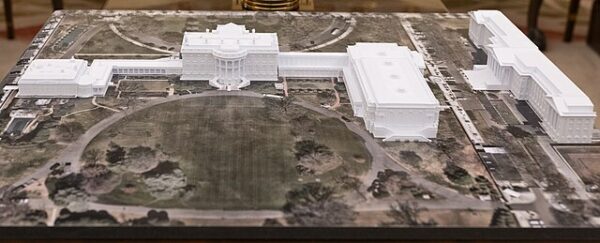
The Supreme Court on Monday cleared the way for construction to continue on President Donald Trump’s new White House ballroom, ruling 5-4 that historic preservation groups challenging the project lacked standing to sue.
The decision allows work to proceed on the 90,000-square-foot ballroom and military complex, which is expected to cost roughly $400 million and includes upgrades to the presidential emergency bunker beneath the White House grounds, writes The New York Times.
The unsigned majority did not rule on whether the project itself is legal. Instead, the justices found the plaintiffs had not shown a direct injury sufficient to bring the lawsuit.
Lower courts had blocked aboveground construction after finding the administration moved forward with major changes to the White House without congressional approval.
Chief Justice John G. Roberts Jr. joined the court’s three liberal justices in dissent, arguing that the construction was “likely unlawful.”
Roberts called the White House “an iconic American building whose symbolism and history are wrapped up in its architecture.”
“All the more reason to ensure that those responsible follow the rules in deciding what to tear down and what to build up at the People’s House,” he wrote.
The National Trust for Historic Preservation brought the lawsuit on behalf of Alison K. Hoagland, a Washington resident and architectural historian who regularly walks past the White House and studies its design.
The majority rejected her claimed “aesthetic, cultural and historical interests,” saying the court has “repeatedly held that mere offense, disagreement or distaste does not qualify as a concrete and particularized injury.”
Roberts disagreed.
“Given the distinctive nature of the White House and Hoagland’s focused and substantiated interest in viewing it in its traditional form, her aesthetic injury from the construction of the ballroom is concrete and particularized,” he wrote.
The Trump administration also argued that halting construction could create national-security risks. Officials now describe the project as a “military/ballroom complex” that includes improvements to the World War II-era Presidential Emergency Operations Center.
Government filings say about 250 workers have been operating 20 hours a day, seven days a week, and that construction is roughly 65 percent complete.
Trump praised the ruling and said the project is expected to be completed by summer 2028.
“We are living in the Golden Age of America, and this Building will be one of the Greatest ever constructed in Washington, D.C.,” Trump wrote. “The magnificent Ballroom and Military Complex will be something that the entire Country is very proud of.”
Brent Leggs, president of the National Trust, said the decision did not resolve the broader legal dispute.
“This is not the final decision on the merits of our case and does not resolve our fundamental argument — that each president is a temporary steward of the People’s House and does not have the unilateral authority to demolish and redesign it without the approval of Congress,” he said.
U.S. District Judge Richard J. Leon had previously halted the project, writing: “While I take seriously the government’s concerns regarding the safety and security of the White House grounds and the president himself, the existence of a ‘large hole’ beside the White House is, of course, a problem of the president’s own making!”
A divided D.C. Circuit panel later agreed that Congress had not given the president authority to “dramatically redesign the ‘People’s House’ to ‘fit a particular president’s desires.’”
Trump has argued the White House lacks sufficient indoor space for large events and has historically relied on tents on the South Lawn. The ballroom replaces the East Wing, which was demolished last fall.
Trump initially said private donations would fund the project, but the administration later transferred about $350 million in taxpayer funds from the Secret Service for security-related work.
For now, the Supreme Court’s standing ruling removes the most immediate legal obstacle to completing the project.