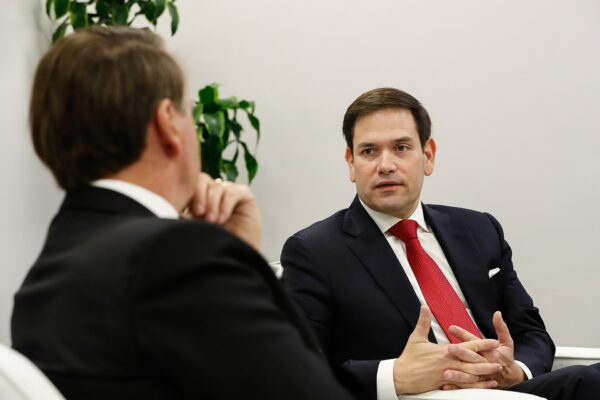
Secretary of State Marco Rubio reportedly pushed back forcefully Sunday against growing Republican criticism of a possible agreement with Iran, calling suggestions that President Donald Trump would allow Tehran to strengthen its nuclear ambitions “absurd.”
Speaking during a press conference in India, Rubio defended the administration’s ongoing negotiations while emphasizing that the White House still prefers diplomacy over a prolonged military confrontation in the Middle East.
“The idea that somehow this president — given everything he’s already proven he’s willing to do — is going to somehow agree to a deal that ultimately winds up putting Iran in a stronger position when it comes to nuclear ambitions is absurd,” Rubio said.
“That’s just not going to happen,” he continued. “But our preference is to address this through a diplomatic means, and that’s what we are endeavoring to do here.”
Rubio added that while negotiators believe progress has been made, any agreement must ultimately be enforced in practice, not merely accepted on paper.
“I think we’ve made some progress,” Rubio said. “I’m always cautious when I say that because you can agree to things on paper; they actually have to be implemented.”
The comments came one day after Trump announced that a deal with Iran was “largely negotiated” following discussions with Arab allies in the region. According to the president, one major element of the agreement would involve reopening the Strait of Hormuz, a critical global shipping route that has remained central to tensions throughout the nearly three-month conflict.
“Final aspects and details of the Deal are currently being discussed and will be announced shortly,” Trump wrote Saturday on Truth Social. “In addition to many other elements of the Agreement, the Strait of Hormuz will be opened.”
Despite the administration’s optimism, several prominent Republicans have raised alarms over reports surrounding the proposed agreement, warning that a poorly structured deal could ultimately strengthen Iran’s regional influence after months of military escalation.
Lindsey Graham argued Saturday that ending the conflict prematurely could leave Iran in a dominant strategic position if Tehran retains the ability to threaten Gulf oil infrastructure and maritime trade.
“If a deal is struck to end the Iranian conflict because it is believed that the Strait of Hormuz cannot be protected from Iranian terrorism,” Graham wrote on X, “then Iran will be perceived as being a dominate force requiring a diplomatic solution.”
Ted Cruz also expressed concern, saying he was “deeply concerned” by reports about an Iran agreement being promoted by some within the administration.
Cruz praised Trump’s earlier military actions against Iran, calling them “the most consequential decision of his second term,” and credited the administration with achieving “extraordinary military results.”
According to Cruz, those results included destroying Iran’s missiles and drones and sinking its navy.
Still, Cruz warned that any agreement allowing the Iranian government to continue uranium enrichment or regain economic strength through sanctions relief would amount to “a disastrous mistake.”
“If the result of all that is to be an Iranian regime — still run by Islamists who chant ‘death to America’ — now receiving billions of dollars,” Cruz wrote, “then that outcome would be a disastrous mistake.”
Former Secretary of State Mike Pompeo also voiced skepticism, comparing the reported negotiations to diplomacy pursued during the Obama administration.
“The deal being floated with Iran seems straight out of the Wendy Sherman-Robert Malley-Ben Rhodes playbook,” Pompeo wrote on X.
The growing divide among Republicans reflects broader uncertainty over how the United States should balance military strength with diplomacy after months of escalating conflict in the Middle East. While administration officials insist diplomacy is the best path to avoid a wider war, critics warn that any agreement perceived as weak could shift power toward Tehran after significant military and economic costs have already been incurred.
[READ MORE: Trump Says He’s In No Rush For Iran Settlement]