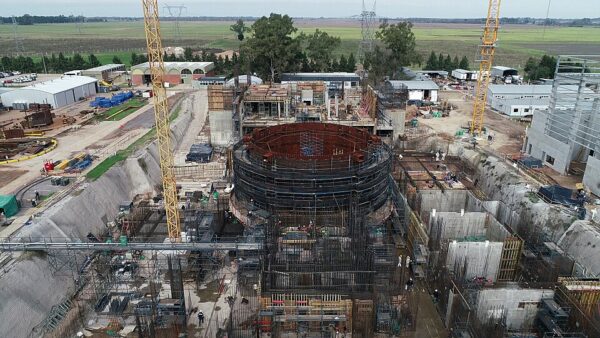
The Nuclear Regulatory Commission issued a permit Nov. 9 to build four advanced nuclear reactors at a Dow chemical complex in Calhoun County, Texas. It was the third advanced reactor project the agency cleared for construction this year. Dow has yet to decide whether to build it.
The permit allows Long Mott Energy to build four of X-energy’s Xe-100 high-temperature gas-cooled reactors at Dow’s Seadrift Operations. The reactors would supply steam to the chemical complex and send surplus electricity to the grid. The permit “does not authorize operation,” a step that requires a separate NRC license.
“Receipt of the construction permit does not represent a final decision by Dow to proceed with construction of the proposed facility,” the company said. Edward Stones, a Dow business vice president, said the company would assess the project “through the lens of competitiveness, execution readiness, and capital affordability before any decision regarding construction is made.”
The Texas project is the first high-temperature gas-cooled reactor design to receive a construction permit in nearly 60 years. NRC staff finished the safety review in October, a month early. The agency had approved construction permits for TerraPower’s Kemmerer Unit 1 in Wyoming in March and the Tennessee Valley Authority’s Clinch River project in September.
“We delivered on the 18-month schedule, proving we can do rigorous safety reviews on predictable timelines that move advanced nuclear technology from design to construction,” NRC Chairman Ho K. Nieh said. He said “Construction permits are being issued ahead of schedule” and urged the agency to keep up that pace. “The NRC cannot backslide from this point. We must adapt on our own as the regulatory landscape changes. It should not take a president’s order or an act of Congress to improve the NRC in the future.”
The approvals follow the bipartisan ADVANCE Act of 2024 and a May 2025 executive order from President Donald Trump that set licensing deadlines. X-energy CEO J. Clay Sell credited “the thorough and efficient work of the NRC, the reforms that have been put in place by the Congress over the last six years, and the phenomenal work of the X-energy and Dow teams.”
Democrats won control of both chambers in the midterms and will take over congressional oversight of the NRC in January. Rep. Frank Pallone, who is expected to chair the House Energy and Commerce Committee, laid out his terms for supporting nuclear legislation in September, explained The Daily Caller.
“I want to once again state that my support for nuclear energy legislation is contingent upon the Nuclear Regulatory Commission and the Department of Energy having sufficient transparency into their safety rules and regulations, so the American public can be sure that our nation’s nuclear industry is safe,” Pallone said. Sen. Jeff Merkley plans to seek the chairmanship of the Senate Environment and Public Works Committee, which oversees the NRC.
“Both Republicans and Democrats recognize the value of nuclear energy.” ClearPath’s Niko McMurray pointed to six nuclear bills that passed the House with bipartisan support. He said the next Congress could continue to support “efficient, predictable licensing that gives companies the certainty to invest in new technologies. That certainty is critical to adding reliable power to the grid and keeping consumer costs down.”
Former NRC Chairman Allison Macfarlane raised a separate concern about the agency’s relationship with the White House. She said the NRC is “no longer an independent regulator and is marching to President Trump’s tune.” Macfarlane warned that “Japan did not have an independent regulator before the Fukushima accident, and we saw the consequences of that,” and urged lawmakers to focus on “the independence of the agency and its ability to fulfill its mission to protect public health, environmental health, and security.”
Adam Stein of the Breakthrough Institute said the Texas approval shows the NRC “can execute rigorous safety and environmental evaluations for multiple new reactor designs on predictable and commercially viable timelines.” The Nuclear Innovation Alliance has supported many of the reforms while calling for greater transparency and “guardrails in place to ensure the continued achievement of adequate protection of public health and the environment.”
Nieh said “the most serious risk to these regulatory reforms is a significant operational event that would undermine the trust and confidence the American people have in nuclear power.” The NRC is also reviewing Holtec’s application for a small modular reactor at the Palisades site in Michigan. It’s worth remembering: There are no low-energy, rich countries.
There are no low-energy, rich countries
Only low-energy poor and high-energy rich oneshttps://t.co/98sdRO4c4o pic.twitter.com/hDVFMI9t8Z
— Bjorn Lomborg (@BjornLomborg) September 22, 2024
For companies seeking to bring new reactors online, the construction permit is the easier of the two licensing steps. MIT professor Jacopo Buongiorno said construction permits require “less time and a lower depth of analysis” than operating licenses, particularly for new designs. For now, he said, the pace of deployment depends on whether developers can secure components and fuel and manage construction.
[READ MORE: Trump Comments Have Conservatives A Little Worried]