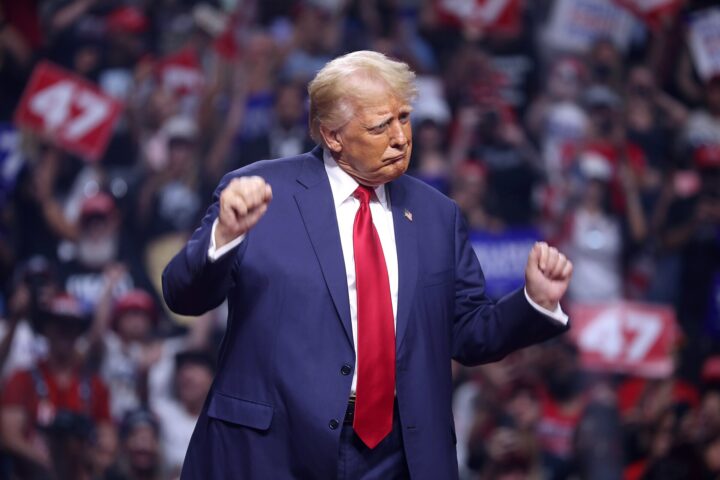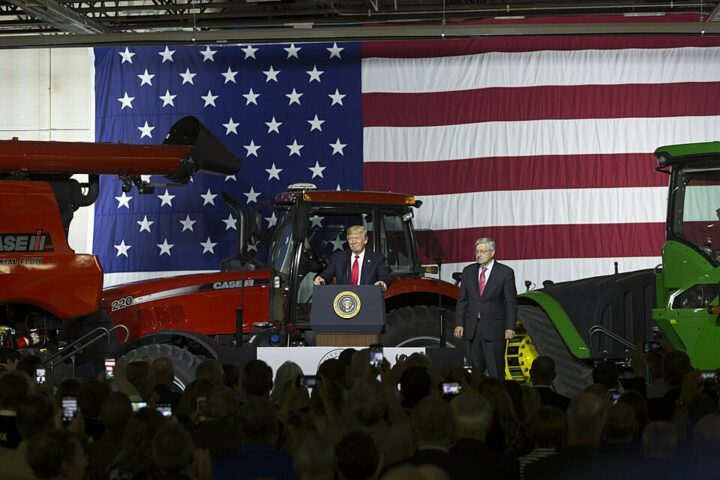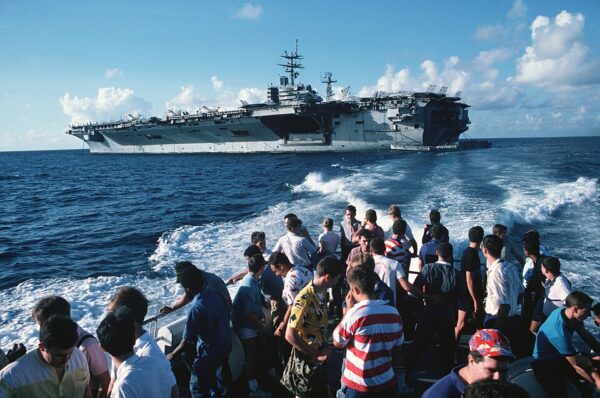
The USS Theodore Roosevelt has reached the Arabian Sea, bringing the number of American aircraft carriers in the Middle East to three, U.S. Central Command announced Monday. Its arrival gives President Donald Trump additional firepower in a war he said last week “militarily is effectively over.”
The Roosevelt left San Diego in September and joins two carriers already enforcing the blockade on Iranian shipping. The USS George H.W. Bush arrived in April and the USS George Washington in August. The Navy last had three carrier strike groups in the region in April, the first such deployment since 2003, according to The Guardian.
The three carriers are operating in the Arabian Sea alongside 13 destroyers, two cruisers and a littoral combat ship, according to the Navy. Two more destroyers are in the Red Sea. The USS Makin Island amphibious ready group, which sailed with the Roosevelt, has yet to reach the region. It includes the amphibious ships USS John P. Murtha and USS Anchorage and carries about 2,000 Marines.
More than eight months into the conflict, Trump has offered differing assessments of how likely American forces are to strike Iran again. Last week, he warned Tehran that the U.S. military was “locked and loaded” and said American forces were monitoring Pickaxe Mountain, a site linked to Iran’s nuclear program. Asked about taking military action, Trump told radio host Hugh Hewitt on Thursday, “If something does not work out, I would not hesitate” to act.
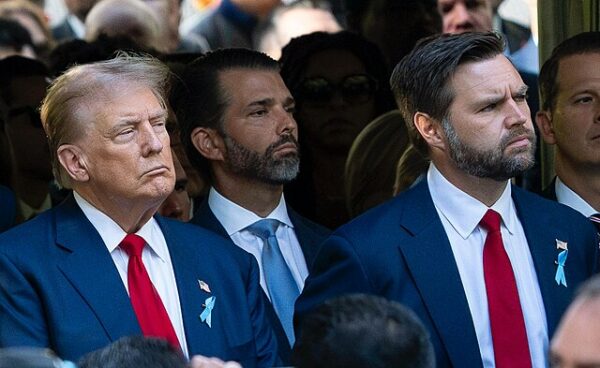
After meeting with Qatar’s prime minister, Trump told reporters he considered another round of major strikes highly unlikely. He has also said the United States no longer needs a deal with Tehran. Vice President JD Vance, who led earlier ceasefire talks, has since been directed by Trump to focus on fraud in Democratic-led cities and states.
The shift in Vance’s duties comes nearly two weeks after Republicans suffered heavy losses in the midterm elections. Analysts and officials attributed some of those losses to public dissatisfaction with the war and its economic costs. Vance offered a blunter assessment, writing on social media that “the reason we lost is the war.”
Negotiations have stalled over Iran’s nuclear program, which Trump has said any settlement must address. Tehran wants Washington to meet several conditions first, including lifting the naval blockade that has kept Iranian oil from reaching world markets. Central Command said U.S. forces have redirected 150 merchant vessels and disabled five since June.
The dispute continues to put commercial ships at risk in the Strait of Hormuz, which carried about a fifth of the world’s oil before the war. American forces have helped ships navigate the waterway and carried out limited strikes on Iranian positions nearby.
On Monday, Iranian state television cited the naval forces of the Revolutionary Guard and the Iranian army in warning shipping companies of mines along a U.S.-backed route through the strait. The Guard’s navy said six oil tankers had struck mines since Sunday and that oil had contaminated parts of the coast.
Separately, the United Kingdom Maritime Trade Operations office reported that a projectile struck a tanker attempting to pass through the strait and started a fire in its engine room. No casualties were reported. Traffic through the strait remains below a third of its prewar volume, according to the maritime analysis firm Lloyd’s List.