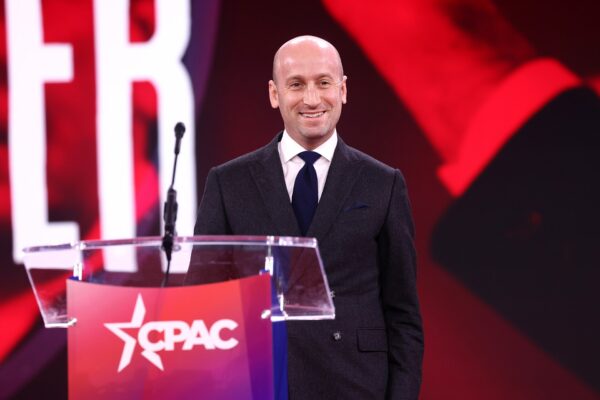
Senior Trump advisor Stephen Miller reportedly said Wednesday that the United States is prepared to sustain its naval blockade of Iranian-linked shipping for as long as necessary, underscoring a strategy that blends economic pressure with the possibility of prolonged military engagement.
Appearing on Fox News with Sean Hannity, Miller discussed the ongoing standoff with Iran following President Donald Trump’s decision to impose a blockade in the Strait of Hormuz. The move came after peace negotiations held in Pakistan over the weekend failed to produce an agreement.
Miller framed the administration’s approach as one rooted in both restraint and strength, describing Trump as “a man of peace” while emphasizing that U.S. policy remains firm when it comes to preventing Iran from acquiring nuclear weapons.
“President Trump wants peace. President Trump wants stability,” Miller said. “But President Trump has also been clear. America will not be trifled with. America will not be bullied, and America will never be threatened by a nuclear-armed Iran.”
At the center of the strategy is the blockade itself, which Miller argued is placing significant economic strain on Iran. By targeting shipping routes through one of the world’s most critical energy corridors, the administration aims to pressure Tehran into returning to negotiations and accepting terms favorable to the United States.
“This embargo is squeezing the economic life out of the Iranian regime,” Miller said, adding that the U.S. has the capability to maintain its presence in the region “indefinitely” if Iran refuses to change course.
At the same time, Miller pointed to the scale of U.S. military power in the region, suggesting that more forceful options remain available, even if they are not the administration’s preferred path. He noted that a broader military operation could severely damage Iran’s energy infrastructure, though he stressed that Trump does not want to pursue that outcome.
“He’s made clear he doesn’t want to do that,” Miller said. “He wants Iran to choose the right path to make a deal.”
The comments highlight a delicate balance: projecting strength while avoiding escalation. Yet the notion of an indefinite military posture raises broader concerns about how long such a strategy can be sustained, particularly given the long history of conflicts that began with limited objectives but stretched on far beyond their original scope.
Trump himself has struck a more optimistic tone, suggesting that the conflict may be nearing its conclusion. In an interview Wednesday with Fox Business host Maria Bartiromo, the president said the situation was “close to over,” offering a contrast to Miller’s emphasis on long-term capacity.
Meanwhile, reports have surfaced that ships linked to Iran have continued to move through the Strait of Hormuz despite the blockade. U.S. Central Command has disputed those claims, leaving some uncertainty about conditions on the ground.
What is clear, however, is the scale of the U.S. military presence in the region. The Pentagon is preparing to deploy thousands more troops to the Middle East, adding to the roughly 50,000 personnel already stationed there.
As the administration presses forward, the strategy appears designed to force a resolution without resorting to a wider war. Still, the reliance on sustained military pressure—and the acknowledgment that it could continue indefinitely—serves as a reminder of how quickly limited actions can evolve into enduring commitments, even when leaders insist their goal is peace.