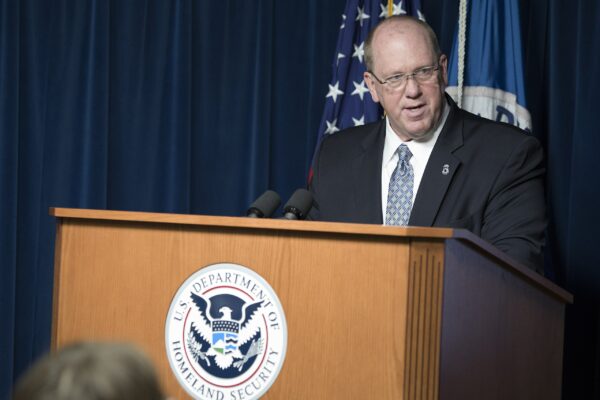
Border Czar Tom Homan says New York City should expect a significant increase in federal immigration enforcement activity after New York Gov. Kathy Hochul signed legislation limiting cooperation between local authorities and Immigration and Customs Enforcement.
Appearing Monday on Fox & Friends, Homan discussed the administration’s plans for immigration operations in New York and responded to recent calls from New York City Mayor Zohran Mamdani to abolish ICE altogether. Homan argued that state and local policies restricting cooperation with federal authorities will ultimately require a larger federal presence on the ground.
The discussion came as Fox & Friends host Brian Kilmeade questioned whether New York’s increasingly hostile stance toward ICE would discourage federal immigration operations in the city.
“So New York is saying abolish ICE and zero cooperation,” Kilmeade said. “The governor and mayor teaming up to make sure that with the progress you were making with Eric Adams is going to just disappear. Are you going to stay away now?”
Homan’s answer was direct.
“No, I’m keeping my promise to Governor Hochul,” he replied.
Homan said he met with Hochul several months ago and attempted to explain what he viewed as the practical consequences of reducing cooperation between local jails and federal immigration authorities.
According to Homan, he pointed to the approach used in Minnesota, where cooperation with sheriffs allows immigration authorities to take individuals into custody in controlled environments such as county jails. He argued that such arrangements reduce the need for officers to conduct arrests in neighborhoods and public settings.
Homan said he warned Hochul that if New York moved forward with legislation restricting that cooperation, ICE would be forced to deploy additional personnel because arrests would become more complicated and potentially more dangerous.
He explained that when authorities cannot take custody of individuals in jail facilities, enforcement teams must instead locate and arrest them elsewhere. According to Homan, that often means entering neighborhoods and attempting to apprehend people in environments where officers face greater uncertainty and security concerns.
Homan said he told Hochul that cooperation between local jails and federal immigration authorities was safer for communities, safer for officers, and safer for the individuals being arrested.
Despite those concerns, Hochul signed the legislation.
“She signed the legislation anyways,” Homan said. “So, I made her a promise.”
The border chief then predicted a major increase in federal immigration enforcement personnel in New York City.
“You are going to see more ICE agents than you have ever seen in New York City,” Homan said.
While declining to provide a specific timetable, Homan indicated that planning for the operation is already underway.
“I just reviewed an operational plan,” he said. “I’m not going to tell you exactly when it’s going to happen, but it’s coming.”
According to Homan, the increased deployment is a direct response to what he described as the loss of efficiencies that come with making arrests in county jail facilities.
The legislation signed by Hochul in late March prohibits ICE agents from wearing masks and prevents local law enforcement agencies from allowing federal immigration authorities to conduct immigration enforcement activities within state and local facilities.
The measure drew criticism from some lawmakers who believed it did not go far enough. Those critics expressed frustration that the legislation stopped short of including explicit prohibitions on all forms of law enforcement cooperation with ICE.
The clash highlights the growing divide between federal immigration enforcement priorities and policies adopted by some state and local governments. As both sides dig in, the dispute appears poised to result in an even larger federal presence in New York, with Homan insisting that reduced cooperation will not lessen enforcement efforts but instead require broader operations in the field.
[READ MORE: Trump Pushes for Immediate Ceasefire as Israel-Iran Fighting Escalates]