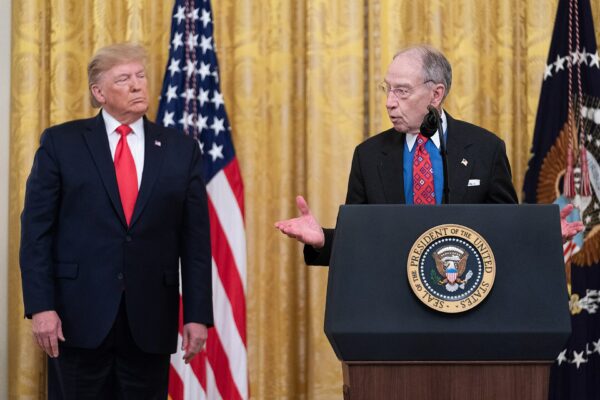
Sens. Chuck Grassley, R-Iowa, and Sheldon Whitehouse, D-R.I., joined forces Thursday to criticize the Treasury Department over a new rule exempting 99% of entities from previous requirements to disclose their beneficial ownership information to federal authorities.
The bipartisan pair warned that the final rule, published Tuesday, weakens the Corporate Transparency Act and strips law enforcement and national security officials of a tool designed to combat illegal financial activity.
“The Treasury Department’s final rule exempting U.S. based companies from the Corporate Transparency Act’s reporting requirements undermines the clear intent of the law,” Grassley and Whitehouse said in a joint statement.
The senators said Congress passed the legislation to provide the federal government with “needed tools” for combating crimes including human trafficking, terrorist financing, drug distribution and sanctions evasion.
“This decision is an unfortunate one that fails to use all available tools to protect Americans and crack down on illicit financial schemes,” they said.
The Treasury Department initially proposed revising the beneficial ownership reporting requirements in March.
FinCEN defines a beneficial owner as someone who directly or indirectly owns or controls a company, either through substantial control or ownership of at least 25% of the company’s interests.
The Trump administration’s new rule overturns a Biden-era requirement intended to crack down on illicit financing.
Treasury Secretary Scott Bessent has defended the change, describing the previous rule as “a burdensome reporting requirement for millions of law-abiding business owners.”
During an interview with WHO Newsradio in Iowa, Bessent argued sophisticated criminal organizations engaged in money laundering would not voluntarily comply with such disclosure requirements.
“With FinCEN, we track the cartels. We track the illegal money going through our system,” Bessent said, arguing Mexican cartels would not simply submit forms acknowledging that they were moving drug money.
Bessent said the Biden-era requirement could instead leave legitimate small businesses facing thousands of dollars in additional compliance expenses.
“All this was going to be was $2,500 more, potentially, to small businesses,” he said. “And we want the businesses to keep that.”
The National Federation of Independent Business praised the Trump administration’s action, saying it could save small businesses as much as $128 billion in regulatory and compliance costs.
NFIB President Brad Close thanked Trump and Bessent for “standing up for Main Street,” saying the rule protects small and independent businesses from an “onerous reporting mandate” while requiring previously submitted personal information to be destroyed.
Congress passed the Corporate Transparency Act as part of the fiscal 2021 National Defense Authorization Act following more than a decade of bipartisan deliberations and consultations with government officials, anti-corruption groups and human rights organizations.
Grassley and Whitehouse were original sponsors of the TITLE Act, a precursor to the legislation.
Treasury announced last year that it would stop enforcing beneficial ownership reporting requirements against U.S. citizens and domestic companies and develop a new rule limiting the requirements to foreign reporting companies.
[READ MORE: Grassley, Whitehouse Blast Treasury Rule Exempting Most US Companies From FinCEN Reporting]