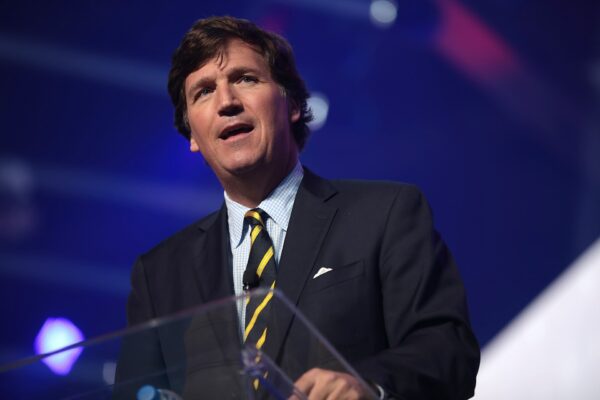
Tucker Carlson forcefully defended his skepticism surrounding the murder of conservative activist Charlie Kirk during Friday’s episode of The Tucker Carlson Show, pushing back after Trump adviser Alex Bruesewitz challenged his comments about the high-profile case.
Carlson and Bruesewitz, a senior social media adviser to President Donald Trump, debated several issues during the interview, including the administration’s policy toward Iran, appearances on Fox News and the handling of the FBI’s Jeffrey Epstein files.
Their sharpest exchange, however, centered on Carlson’s repeated public doubts about the official account of Kirk’s death.
Since Kirk’s assassination last year, Carlson has repeatedly questioned whether the publicly identified suspect, Tyler Robinson, acted alone. Robinson has been accused of fatally shooting Kirk and allegedly confessed in a text message to his roommate, but Carlson has continued to argue that additional questions remain unanswered.
During Friday’s interview, Bruesewitz confronted Carlson over comments he believed Carlson had made during another podcast appearance.
“You were on a podcast yesterday, and you said you think Israel killed Charlie Kirk,” Bruesewitz said.
Carlson immediately rejected that characterization.
“I did not say that,” Carlson responded. “I’ve never said that. I know a lot of people, including in the Trump administration, think that. However, there’s no proof of that.”
Carlson then explained what he said he had actually argued.
According to Carlson, he does not believe Americans should simply accept the conclusions of federal law enforcement without scrutiny.
“What I said was two things,” Carlson began. “One — I don’t know when the command came down and from whom that we have to trust everything federal law enforcement says, but I’m not obeying that.”
Carlson argued that citizens have a responsibility to press investigators to thoroughly examine major crimes.
“We have a moral obligation to push federal law enforcement to do the job we pay them to do, which is to investigate the crimes fully,” he said.
As an example, Carlson pointed to social media posts that he said appeared to predict Kirk’s death before it occurred. He questioned whether those posts had been investigated.
“If there are people who predicted Charlie’s death on Twitter, I think the rest of us can expect that they’ve been hauled in by the FBI for questioning, and I don’t think they have been,” Carlson said.
Bruesewitz replied that he was familiar with discussion involving Discord chats and TikTok but said he did not know whether the Twitter posts Carlson referenced had been investigated.
“I don’t know if that’s been investigated. I would love for that to be,” Bruesewitz said.
Carlson then expanded on his broader concerns about the case.
He argued that the existence of one alleged shooter would not necessarily rule out the involvement of other individuals.
“Just because someone is shot by one person doesn’t mean others weren’t involved,” Carlson said. “And don’t, like, berate me into accepting that assumption because I would never. Why would I assume that?”
Carlson also objected to what he viewed as definitive claims regarding the motive for Kirk’s killing before the criminal trial has begun.
“To tell me that you know the motive before the trial even starts, to tell me that he was killed for his views on transgenders — maybe he was. Maybe it was more complicated than that. How would you know? You don’t know,” Carlson said.
He concluded by urging others not to pressure him into accepting conclusions he believes have not yet been proven.
“Stop yelling at me to accept a conclusion that you can’t prove. Why would you do that? This is my friend,” Carlson said.
[READ MORE: Massie Warns GOP Faces ‘Absolute Shellacking’ in Midterms if Party Doesn’t ‘Wake Up’]