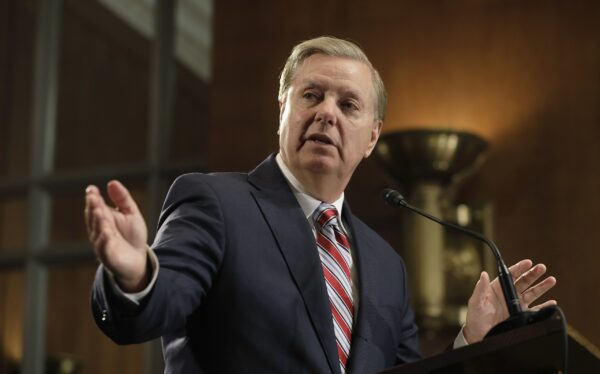
Sen. Lindsey Graham (R-S.C.) offered a series of bold predictions about the future of U.S.-Iran relations during a Sunday appearance on Face the Nation, arguing that diplomatic efforts are unlikely to succeed and warning that the United States would respond forcefully if Iran challenged American control of the Strait of Hormuz.
Speaking with host Margaret Brennan, Graham said he remains skeptical of the recently announced Memorandum of Understanding between the United States and Iran. While he described the agreement as “problematic,” he also said diplomacy deserves an opportunity before more drastic measures are considered.
“Let’s try a diplomatic solution,” Graham said. “[But] I think it’s going to fail.”
The South Carolina Republican then laid out what he believes could happen if negotiations ultimately break down. Asking, “What happens next?” Graham proceeded to answer his own question with a prediction that the United States would take direct control of the strategically important Strait of Hormuz.
According to Graham, the U.S. would secure the critical shipping route by force if necessary and oversee maritime traffic through one of the world’s most important energy corridors.
“We will control the Strait of Hormuz,” Graham said, adding that ships passing through the waterway would be charged a fee to help pay for the operation.
The senator also predicted broader geopolitical developments, saying he believes the United States would continue expanding the Abraham Accords and that Saudi Arabia would join the agreements by the end of 2026.
But Graham reserved his strongest remarks for the possibility that Iran could challenge American authority in the region.
“And if Iran contests control of the Strait of Hormuz by the United States, we will obliterate them,” Graham said.
The comments are consistent with Graham’s long-standing support for a hardline approach toward Iran. He has been among President Donald Trump’s most vocal allies regarding the conflict and has frequently argued for aggressive measures against the Iranian regime.
A month before the launch of Operation Epic Fury, Graham publicly urged Trump to kill Iranian Supreme Leader Ali Khamenei. During the same period, he also secured Trump’s signature on a “Make Iran Great Again” baseball cap, a slogan that drew attention as tensions between Washington and Tehran continued to escalate.
Graham’s remarks came as Vice President JD Vance traveled to Switzerland in an effort to advance negotiations with Iranian officials. The diplomatic talks represent one of the most significant attempts to reach a lasting peace framework since the conflict intensified.
The contrast between ongoing negotiations and warnings of potential military action underscores the uncertainty surrounding the future of the agreement. While diplomats are working toward a settlement, many questions remain about whether the two sides can bridge their differences and avoid renewed confrontation.
President Trump also addressed the Strait of Hormuz issue earlier Sunday during comments reported by Fox News correspondent Trey Yingst.
According to Yingst, Trump said he spoke by phone with Iranian leaders and delivered a stark warning about the consequences of closing the waterway.
“You close it, and you won’t have a country,” Trump reportedly said. “You won’t even make it back to your f*cking country.”
The Strait of Hormuz remains a central issue in negotiations because of its importance to global shipping and energy markets. As diplomatic efforts continue, Graham’s comments reflect a view held by some Republicans that while negotiations may be worth attempting, the United States should be prepared to act decisively if talks collapse and tensions escalate once again.
For now, diplomacy remains underway, but both Washington and Tehran continue to face high-stakes decisions that could shape the region’s future.
[READ MORE: Trump Says There Are ‘No Limits’ to Presidential Power After Iran Conflict]