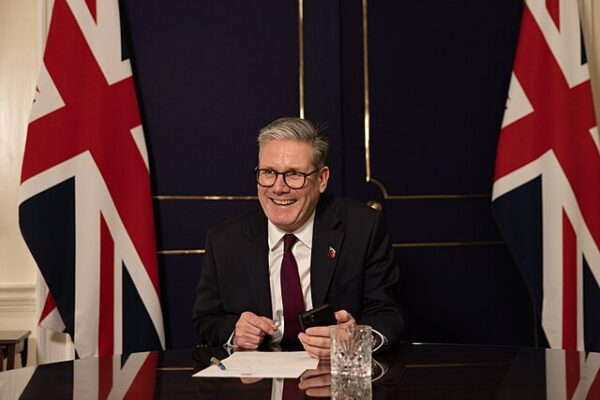
British Prime Minister Keir Starmer announced Monday that he will step down as leader of the Labour Party once a successor is chosen, bringing a dramatic chapter in British politics closer to an end after just over a year in office.
Speaking outside his official residence at 10 Downing Street, Starmer said he had informed King Charles III of his decision and outlined a timetable intended to ensure a smooth transition of leadership.
Starmer said he would instruct Labour’s National Executive Committee to open nominations for the party leadership contest beginning July 9 and continuing until Parliament’s summer recess on July 16.
“In the case of a contest, this will ensure a new leader is in place before Parliament returns in September,” Starmer said.
While relinquishing party leadership, Starmer made clear that he will remain prime minister until the contest is completed.
“I will remain in post as prime minister until the contest is complete, and I will do everything I can to ensure an orderly handover of power,” he said.
The announcement marks a significant turn for a leader who only entered office in July 2024 after leading Labour to victory and ending 14 years of Conservative Party rule in the United Kingdom. But despite the historic win, public support for Starmer deteriorated quickly.
A recent Ipsos survey found that roughly two-thirds of respondents believed Starmer should not lead Labour into the next general election, highlighting the growing dissatisfaction that had developed within both the electorate and his own political movement.
Starmer’s tenure was also overshadowed by controversy surrounding his appointment of Peter Mandelson as British ambassador to the United States. Mandelson was later dismissed after revelations regarding his ties to convicted sex offender Jeffrey Epstein.
Earlier this year, Mandelson was charged on suspicion of misconduct in public office in connection with that association.
Starmer’s resignation came one day after President Donald Trump publicly predicted the British leader’s departure. In a Truth Social post on Sunday, Trump said Starmer was resigning and criticized him for what he described as failures on immigration and energy policy.
The race to replace Starmer began taking shape almost immediately following the announcement. Andy Burnham, a Labour politician who served as mayor of Greater Manchester and recently won a special election for a parliamentary seat, confirmed Monday that he intends to seek the party leadership.
“The country expects stability, seriousness and a continued focus on the issues that matter most and that is what it will get,” Burnham wrote on X.
Whoever succeeds Starmer will become Britain’s sixth prime minister since David Cameron stepped down following the 2016 referendum in which the United Kingdom voted to leave the European Union.
Although the next general election does not have to be held until August 2029, British law allows the prime minister to call an election before that deadline.
During his farewell remarks, Starmer defended his record in office and pointed to what he described as accomplishments under his government, including economic growth, wage growth, improvements to the National Health Service, increased defense spending, and support for Ukraine during its war with Russia.
At the same time, he acknowledged that the central question facing Labour had shifted from whether he was the right person to bring the party back to power to whether he was the right person to lead it into another national campaign.
“I have heard the answer of my parliamentary party to that question, and I accept that answer with good grace,” Starmer said.
The prime minister became emotional near the conclusion of his remarks, praising his wife, Victoria Alexander, and speaking about his desire to spend more time with his family. He said he would focus on being “the best husband” and “best dad” he could be to their two children.
After concluding his speech, Starmer embraced his wife before the two walked back into the prime minister’s residence together.
[READ MORE: Trump Says There Are ‘No Limits’ to Presidential Power After Iran Conflict]