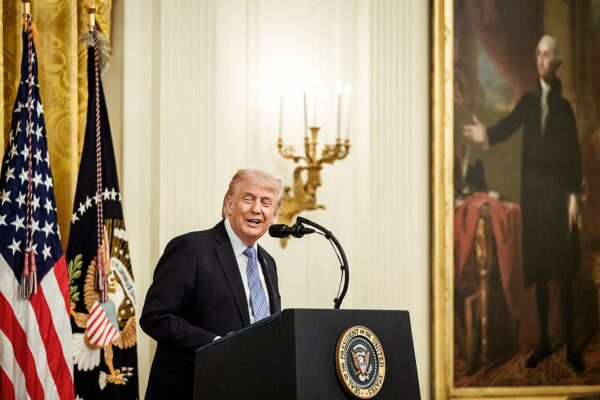
President Donald Trump reportedly said Monday that he is “seriously considering” the possibility of making Venezuela the 51st state of the United States, adding another striking chapter to the administration’s already extraordinary involvement in the South American nation.
According to Bill Melugin, Trump made the remarks during a conversation with John Roberts. The president reportedly said “Venezuela loves Trump” and pointed to the country’s enormous oil reserves, which he claimed total roughly $40 trillion.
The comments come months after U.S. forces carried out a military operation in January that resulted in the capture of Venezuelan President Nicolás Maduro and his wife, Cilia Flores. Maduro was transported to New York and remains imprisoned following the operation.
Since Maduro’s removal, Venezuela has been led by acting President Delcy Rodríguez, who previously served as vice president under Maduro. The administration has portrayed relations with Rodríguez as positive, especially regarding oil production and exports.
In the immediate aftermath of the January operation, Trump drew headlines with a social media post declaring himself the new president of Venezuela. He also announced plans involving Venezuelan oil exports, saying revenues from the sales would be controlled by him as president to benefit both Venezuela and the United States.
“I am pleased to announce that the Interim Authorities in Venezuela will be turning over between 30 and 50 MILLION Barrels of High Quality, Sanctioned Oil, to the United States of America,” Trump wrote at the time. He added that the proceeds would be managed under his authority to ensure they were used properly.
The administration has repeatedly emphasized Venezuela’s energy potential as a central factor in the evolving relationship between the two countries. In February, Trump praised Rodríguez for what he described as doing “a very, very good job” in overseeing Venezuela during the transition period. He also highlighted increased oil activity and said the United States was uniquely positioned to refine Venezuelan crude.
“The oil is coming out,” Trump said at the time, while describing relations between the countries as strong.
At the same time, the developments have fueled ongoing debate over the scope of American power abroad. The January military operation drew international scrutiny and reopened questions about presidential war powers, regime change, and the long-term consequences of foreign intervention.
Trump’s latest comments about statehood are certain to intensify that discussion. While supporters may see the remarks as another example of Trump’s unconventional negotiating style and emphasis on American energy interests, critics have continued to question how far U.S. involvement in Venezuela should go.
For now, the proposal remains only an idea publicly floated by the president. Any move toward statehood would face enormous legal and political hurdles. Still, the fact that such a conversation is occurring at all underscores how dramatically the relationship between Washington and Caracas has changed in just a few months.